

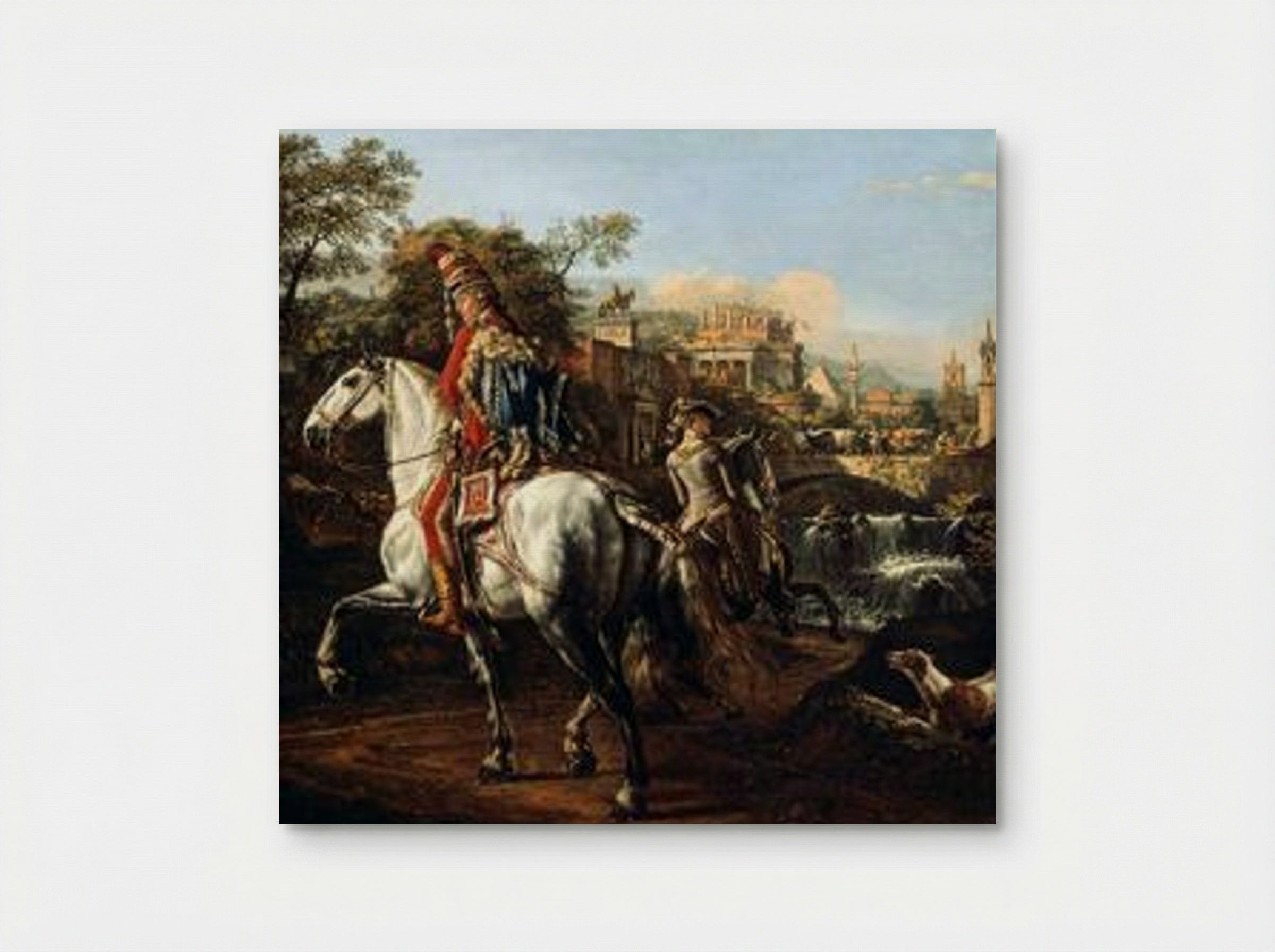
En husar till häst – Bernardo Bellotto
Arkivbeständigt giclée-tryck
Ramar levereras klara att hängas upp
Säker utcheckning
Tillverkad på beställning
Beskrivning
Denna oljemålning på duk av Bernardo Bellotto föreställer en husar till häst, mot en detaljerad stadsbild. Konstnärens öga för detaljer är tydligt i återgivningen av hästarnas muskulatur och soldaternas uniformer.
Bernardo Bellotto (1722-1780) var en italiensk stadsmålare, även känd som och signerade sig som Canaletto, precis som hans farbror Giovanni Antonio Canal var känd. Bellotto föddes i Venedig och blev elev till sin farbror. Han arbetade också i Rom, Florens, Verona och Milano. Efter att hans farbrors stil blivit populär gjorde Bellotto en självständig karriär i flera europeiska städer, inklusive Dresden, Wien och Warszawa. ”En husar till häst” visar en beriden soldat i en utarbetad dräkt, åtföljd av en annan ryttare och en hund, mot en detaljerad stadsbild. Kompositionen balanserar förgrundsfigurerna med de avlägsna arkitektoniska elementen, vilket skapar en känsla av djup och skala. Konstnärens öga för detaljer är tydligt i återgivningen av hästarnas muskulatur och soldaternas uniformer. Det mjuka, diffusa ljuset förstärker den atmosfäriska perspektivet och bidrar till den övergripande känslan av realism.
Returpolicy
Eftersom varje tryck görs på beställning erbjuder vi inte returer, återbetalningar eller byten på grund av ändrade åsikter. Om din beställning kommer fram felaktig, skadad eller fel, ersätter vi den kostnadsfritt – kontakta oss bara inom 48 timmar efter leverans. Se vår återbetalningssida för fullständig information.
Frakt
Vi skickar till hela världen och trycker vid den produktionsanläggning som är närmast din leveransadress. Leveranstider och kostnader varierar beroende på destination – du ser tillgängliga alternativ i kassan.
Tillverkning
Varje tryck produceras på beställning med 12-färgs gicléetryck på FSC-certifierat arkivpapper. Designade i Storbritannien och tryckta vid närmaste produktionsanläggning för att minska avfall och snabba upp leveransen.
En husar till häst – Bernardo Bellotto

Artist Biography
Bernardo Bellotto
Born in Venice in 1721, Bellotto was the nephew of Giovanni Antonio Canal on his mother's side and trained in his uncle's studio from early adolescence. By his mid-teens he was a registered member of the Venetian painters' guild. His early work so closely followed Canaletto's manner that he occasionally signed canvases "Canaletto" himself, a habit that has tangled attribution ever since. He left Venice in 1746 for a long Italian tour before heading north; in 1747, aged twenty-six, he accepted an invitation to Dresden from Frederick-Augustus II, Elector of Saxony, who paid him twenty thalers a year as court painter.
The Dresden commissions produced some of his finest work: The Moat of the Zwinger (1749-53, 133 x 235 cm, Gemaldegalerie) and a series of Neumarkt views including the Frauenkirche, in which extreme diagonal compositions amplify the spatial depth of the city's Baroque squares. Empress Maria Theresa summoned him to Vienna in 1758, where he painted View from the Belvedere (1759-60, Kunsthistorisches Museum); in 1767 he moved to Warsaw, entering the service of Stanislaw II of Poland and beginning the topographical documentation that would outlast the city itself.
His palette runs consistently cooler and crisper than Canaletto's; he paid more attention to cloud formations, deep shadows, and foliage, and packed his views with more figure groups. Where Canaletto often revisited the same standpoints, Bellotto almost always sought new vantage points. Scholars read his documentary precision as a function of his market: not Venice's tourist trade but the royal courts of Europe, patrons who wanted their capitals recorded with near-surveyor exactitude.
Våra funktioner
Utformad för varaktig inverkan
Specifika funktioner
Varje Solis-konstverk tillverkas på beställning med arkivbeständiga material av gallerikvalitet som är byggda för att hålla.
- Giclée-tryck i museikvalitet för fylliga, blekningsbeständiga färger
- Arkivbeständigt matt konstpapper, FSC-certifierat
- Flera storlekar och inramningsalternativ tillgängliga
- Ramar i svart, naturträ, mörkt trä eller vitt
- Inramade tryck levereras klara att hänga upp
Skötsel & rengöring
För att bevara ditt konstverk i bästa skick:
- Damma försiktigt med en mjuk, torr trasa
- Undvik långvarigt direkt solljus
- Använd aldrig flytande rengöringsmedel på trycket eller dukytan
- Förvara på en torr plats i rumstemperatur
- Hantera tryck med rena, torra händer
Material och storlek
Gicléeutskrift av museikvalitet på FSC-certifierat matt arkivpapper, med inramade alternativ och alternativ på canvas.
- Pappersstorlekar: A4, A3, A2, A1, A0 och B2 (50×70 cm)
- Canvas: XS (20×30 cm) till Large (60×90 cm)
- Ramar: svart, naturligt trä, mörkt trä eller vit
Varför välja oss?
Leveransgaranti utan skador
Snabb leverans
Material av museikvalitet
Artistbiografi
Bernardo Bellotto
Born in Venice in 1721, Bellotto was the nephew of Giovanni Antonio Canal on his mother's side and trained in his uncle's studio from early adolescence. By his mid-teens he was a registered member of the Venetian painters' guild. His early work so closely followed Canaletto's manner that he occasionally signed canvases "Canaletto" himself, a habit that has tangled attribution ever since. He left Venice in 1746 for a long Italian tour before heading north; in 1747, aged twenty-six, he accepted an invitation to Dresden from Frederick-Augustus II, Elector of Saxony, who paid him twenty thalers a year as court painter.
The Dresden commissions produced some of his finest work: The Moat of the Zwinger (1749-53, 133 x 235 cm, Gemaldegalerie) and a series of Neumarkt views including the Frauenkirche, in which extreme diagonal compositions amplify the spatial depth of the city's Baroque squares. Empress Maria Theresa summoned him to Vienna in 1758, where he painted View from the Belvedere (1759-60, Kunsthistorisches Museum); in 1767 he moved to Warsaw, entering the service of Stanislaw II of Poland and beginning the topographical documentation that would outlast the city itself.
His palette runs consistently cooler and crisper than Canaletto's; he paid more attention to cloud formations, deep shadows, and foliage, and packed his views with more figure groups. Where Canaletto often revisited the same standpoints, Bellotto almost always sought new vantage points. Scholars read his documentary precision as a function of his market: not Venice's tourist trade but the royal courts of Europe, patrons who wanted their capitals recorded with near-surveyor exactitude.
Du kanske också gillar