


Tsukioka Yoshitoshi (1839-1892) is usually called the last great master of ukiyo-e, the Japanese woodblock print. His masterpiece, One Hundred Aspects of the Moon (Tsuki hyakushi), pairs the moon with a hundred figures from Japanese and Chinese history and legend: a general on a night raid, an exiled poet, a fox spirit, an empress. He began publishing it in instalments from about 1885, and the last of the hundred sheets reached buyers only shortly before he died in 1892, completing the series in the same year as his own death. Through those same years, photography studios and imported mechanical presses were taking over the newspaper and portrait trade that had kept woodblock publishing solvent for two centuries. Yoshitoshi spent much of his working life in poverty and suffered repeated episodes of mental illness, one of them severe enough to put him in hospital. He kept working through all of it, and raised the woodblock print to one of its highest points at the exact moment the trade that had produced it was dying around him.
A Merchant's Son in Kuniyoshi's Studio
Yoshitoshi was born Owariya Yonejiro on 30 April 1839, in the Shimbashi district of Edo. His father was a merchant who had bought the family's way into samurai rank, a common transaction in the last decades of the shogunate. Sent to live with an uncle, a pharmacist, at the age of three, he had begun drawing lessons by five.
At eleven he was apprenticed to Utagawa Kuniyoshi, already one of Edo's most established print masters. Kuniyoshi had studied Western engravings and, unusually for a woodblock studio, had his pupils draw from live models rather than copy stock poses. He gave his new student the art name Yoshitoshi. The boy's first known print appeared in 1853, when he was fourteen, and he went on designing under Kuniyoshi's supervision through the 1850s. Kuniyoshi died in 1861; Yoshitoshi was in his early twenties, and already working independently in one of Edo's most crowded trades.
The Bloody Prints of the 1860s
By the mid-1860s Yoshitoshi had a reputation for violence on the page. Wakan hyaku monogatari ("One Hundred Ghost Tales of China and Japan"), begun in 1865, mixed old folklore with images meant to unsettle. In 1866 and 1867 he and a fellow Kuniyoshi pupil, Utagawa Yoshiiku, published Eimei nijuhasshuku ("Twenty-Eight Famous Murders with Verse"), each artist contributing fourteen sheets. The series became the defining example of muzan-e, the "cruel pictures" genre: close studies of torture and killing, printed with pigment mixed into the glue to suggest congealed blood.
The timing was not accidental. These were the final years of the Tokugawa shogunate, swept away by the Meiji Restoration of 1868, and Edo's print publishers were selling plenty of real political violence alongside the invented kind. Yoshitoshi followed the fall of the old government directly with Kaidai hyaku senso (1868), responding to the Battle of Ueno, fought a few streets from his own studio as shogunate loyalists made their last stand against imperial troops.
Poverty, Breakdown, and the Name Taiso
Success did not hold. By 1869 critics ranked Yoshitoshi among the best woodblock designers working in Japan, but commissions fell away within two years. Depression set in, and in 1872 it became a full breakdown. He was living at the time with a woman named Okoto, in conditions poor enough that the couple burned their own floorboards for fuel. Okoto eventually sold herself into a brothel to keep him working.
Yoshitoshi recovered in 1873 and marked it by changing his art name from Ikkaisai to Taiso, meaning great resurrection. The new Meiji press gave him a market he had not had before: illustrated newspapers needed woodblock artists to draw current events for a mass readership, and Yoshitoshi supplied that market for the rest of the decade. The Satsuma Rebellion of 1877 brought him a further run of newspaper work.
Japan's Most Popular Print Artist
Through the late 1870s and early 1880s Yoshitoshi built a following with Dai Nihon meisho kagami ("Mirror of Famous Generals of Great Japan"), a run of warrior portraits for the publisher Funazu Chujiro. By 1882 he was financially secure for the first time in his career. Fujiwara no Yasumasa Playing the Flute by Moonlight, from 1883, is usually named among his strongest single compositions: a court noble walks on undisturbed while a would-be attacker hesitates, stopped by the sound of the music.
In 1880 Yoshitoshi had met Sakamaki Taiko, a former geisha with two children; they married in 1884, and he adopted her son, who trained under him and later worked, as Tsukioka Kogyo, on prints of Noh theatre. That same year, Japan's print publishers and booksellers named Yoshitoshi the country's most popular ukiyo-e artist.
A Hundred Moons, A Hundred Stories
One Hundred Aspects of the Moon began appearing in 1885, published in instalments by Akiyama Buemon. Yoshitoshi eventually completed a hundred sheets, oban size, each pairing the moon with a scene from Japanese or Chinese history and legend. The moon itself is not always shown; the connecting idea is that every episode in the series takes place beneath it.
Early sheets include Inaba Mountain Moon, showing the young Toyotomi Hideyoshi leading a night climb up a cliff face to help Oda Nobunaga take an enemy castle, and Moon of the Enemy's Lair, in which the prince Yamato Takeru, disguised as a woman, waits to draw a sword hidden beneath his robe at a rebel feast. Other sheets turn to Chinese legend, with Chang'e fleeing to the moon after stealing the elixir of immortality, or to older Japanese folklore, with the story of an old woman abandoned on a mountainside. Buyers are reported to have queued before dawn for new instalments as they appeared. The series ran for seven years and was still unfinished when Yoshitoshi's health began to fail for the last time.
New Forms of Thirty-Six Ghosts
Yoshitoshi began his last major series, Shinkei sanjurokkaisen ("New Forms of Thirty-Six Ghosts"), in 1889. It returned to the ghost stories of his early muzan-e years, but the handling was different. Where the 1860s prints went for shock, the ghost series works through suggestion. One sheet shows Oiwa, the wronged wife of the kabuki play Yotsuya Kaidan, calmly nursing her infant; the only warning of what is coming is a sash that curls across the print like a snake.
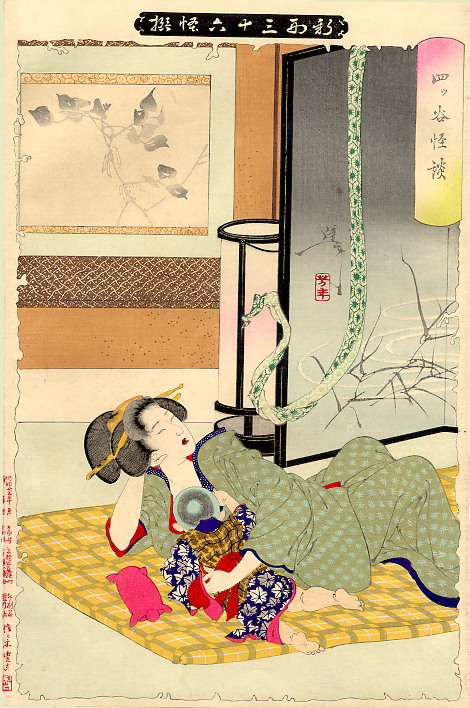
Thirty-six sheets and a title page were planned. Three were printed and published only after Yoshitoshi's death, from designs he had already completed.
The Last Print, and the End of a Form
Yoshitoshi's health failed for the last time in early 1891. He suffered a relapse severe enough that he believed, wrongly, that he was hosting a gathering of fellow artists in his own home; soon afterwards, thieves took what money he had. He was admitted to hospital. One Hundred Aspects of the Moon was still appearing in instalments, and its final sheet reached the public only shortly before his death, completing the run of a hundred within his own lifetime.
Yoshitoshi left hospital in May 1892 but did not go back to his own house, renting rooms instead. He died on 9 June 1892, in Ryogoku, Tokyo, of a cerebral haemorrhage. He was fifty-three. He had already named his student Mizuno Toshikata as his successor; Migita Toshihide and others carried the studio's work on, and Yoshitoshi is thought to have trained something close to eighty pupils over his career. A stone memorial was raised in Tokyo's Mukojima Hyakkaen garden in 1898.
He worked through the years that made his own trade obsolete. Photographic studios and imported mechanical presses took over the newspaper illustration and portrait work that had financed woodblock publishing for two centuries; by the 1890s, colour woodblock printing survived mainly as a specialist practice rather than a mass medium. The biographer Roger Keyes titled his 1982 study of the artist Courage and Silence; the historian John Stevenson judged that Yoshitoshi's work "gave ukiyo-e another generation of life." His prints are now held by, among others, the Library of Congress, the Museum of Fine Arts in Boston, the Art Gallery of New South Wales, and Yale University Art Gallery. One Hundred Aspects of the Moon remains the most reproduced of his series and is still exhibited as a complete set of a hundred.


