


In 1072 the court painter Guo Xi signed and dated a large hanging scroll called Early Spring, made for the Song court. It shows no place a traveller could find and stand in. Mist pools between crags that swell and recede as though breathing, and a fisherman's boat and a mule train surface and vanish among rock forms built from years of habit and convention, not from a morning spent sketching one hillside. Guo Xi did not pretend otherwise: in his writings on landscape, recorded by his son, he said a good painting let a city-bound official travel in his mind without leaving his desk. Within two generations, the scholar-officials who collected and judged paintings like his had turned that same idea, that a landscape is made rather than copied, into an argument against professional painters altogether. For roughly a thousand years, from the Tang poet Wang Wei to the Ming critic Dong Qichang, China's scholar-officials, the literati, painted mountains and water (shanshui) as self-cultivation, a private discipline rather than a trade. Painting for a fee was looked down upon. They looked hard at real mountains. What they refused was the idea that looking, on its own, was the point.
An Ancestor Chosen After the Fact
Wang Wei (699 to 759) is the tradition's usual starting point, though he did not set out to found one. He was a Tang dynasty official who wrote poetry and painted as a private pursuit, and almost nothing he painted survives in a form anyone can trust. His reputation as the ancestor of literati landscape was built three centuries later by the poet and official Su Shi, who wrote a colophon on a Wang Wei painting of misty hills at Lantian, since lost, and delivered a verdict that stuck: that there was a painting hidden inside Wang Wei's poems, and a poem hidden inside his paintings. That line did more to place Wang Wei at the head of the tradition than anything Wang Wei painted. The literati chose their ancestor after the fact, then wrote the history backwards from that choice.
Meaning Over Likeness
The clearest statement of the literati position comes from the eleventh century. The scholar-official Ouyang Xiu wrote that painters of the past had painted meaning, not outer form. His younger contemporary Su Shi went further: "Anyone who judges painting by likeness has the understanding of a child." Su Shi ranked a Tang court muralist, Wu Daozi, below Wang Wei for the same reason. Wu Daozi could paint anything, Su Shi conceded, but he remained a mere craftsman, while Wang Wei's simpler, sparer mural reached something beyond the image itself. The connoisseur and collector Mi Fu argued the same point from another angle: horses and oxen could be copied from life and still convince, but a copied landscape never succeeds, because its value lay in the painter's own thought rather than in the scene before him.
Li Gonglin, part of Su Shi's circle, put the theory into practice. He painted his family estate in the Longmian Mountains while sitting in the capital, hundreds of miles from the actual site, in a deliberately archaic style that resembled no real hillside anyone could visit. That invented estate, not a sketch made on the spot, was the literati's idea of a true likeness.
Ink Before Colour
Brush and ink took priority over colour for reasons of status as much as taste. Every scholar who sat the civil service examinations had to write well, and examiners marked calligraphy nearly as closely as content, so a clumsy hand could sink an able essay. Critics judged calligraphy as a direct record of character, and landscape painters carried the same standard into their texture strokes (cunfa), built from the same wrist movements as handwriting. A painting could be read, like a letter, for the quality of the mind behind it.
Mineral colour, especially the blue-and-green palette used on decorative and courtly landscapes, took skilled preparation and time, and it was associated with the paid professional's workshop. Ink and paper were cheap, and forgiving of a spontaneous hand: a scholar could pick up a brush after dinner and paint from feeling, but he could not mix and layer malachite green so casually. Monochrome ink was not a limitation literati painters worked within. It was the version of the medium suited to a man with another job.
A Poem, a Seal and a Painting on One Sheet
Chinese critics called the combination of poetry, calligraphy and painting on a single work the "three perfections" (sanjue), a term first recorded in the New Book of Tang. A literatus rarely handed over a finished, sealed object the way a commissioned professional did. He often added his own poem into the blank space above the ink mountains, then left room for friends and later owners to add colophons and seals of their own over the centuries. Some scrolls reached the twentieth century carrying inscriptions from half a dozen different hands and eras, a private conversation still being carried on in the margins.
Format mattered too. A hanging scroll was displayed briefly, then rolled and put away. A handscroll was never displayed at all in the Western sense: it was unrolled a little at a time, right to left, in the company of one or two friends, so that a mountain journey unfolded exactly as slowly as its owner allowed. Neither format was built for a shop wall.
From a Monumental Cliff to an Empty Riverbank
Fan Kuan, who died around 1023, is said to have turned down official life and studied mountains directly, spending days seated beneath cliffs and nights walking the snow-covered hills by moonlight. The result, Travellers among Mountains and Streams, is not a record of that experience. It is a single invented massif nearly seven feet tall, cropped at the edges as though there were more mountain than the silk could hold, with a mule train and two travellers reduced to a detail near its base. Direct observation fed the picture. It did not dictate its shape.
Three centuries later, after the Song collapse and the Mongol conquest, that same discipline turned austere. Ni Zan (1301 to 1374), one of four painters later grouped together as the Yuan masters, gave away his property rather than serve the new court and spent his last decades moving between the houses of friends around Lake Tai. His late paintings repeat one composition: a foreground bank scattered with a few thin trees, then a wide empty river standing between it and a low, distant shore. A figure is almost never in sight.
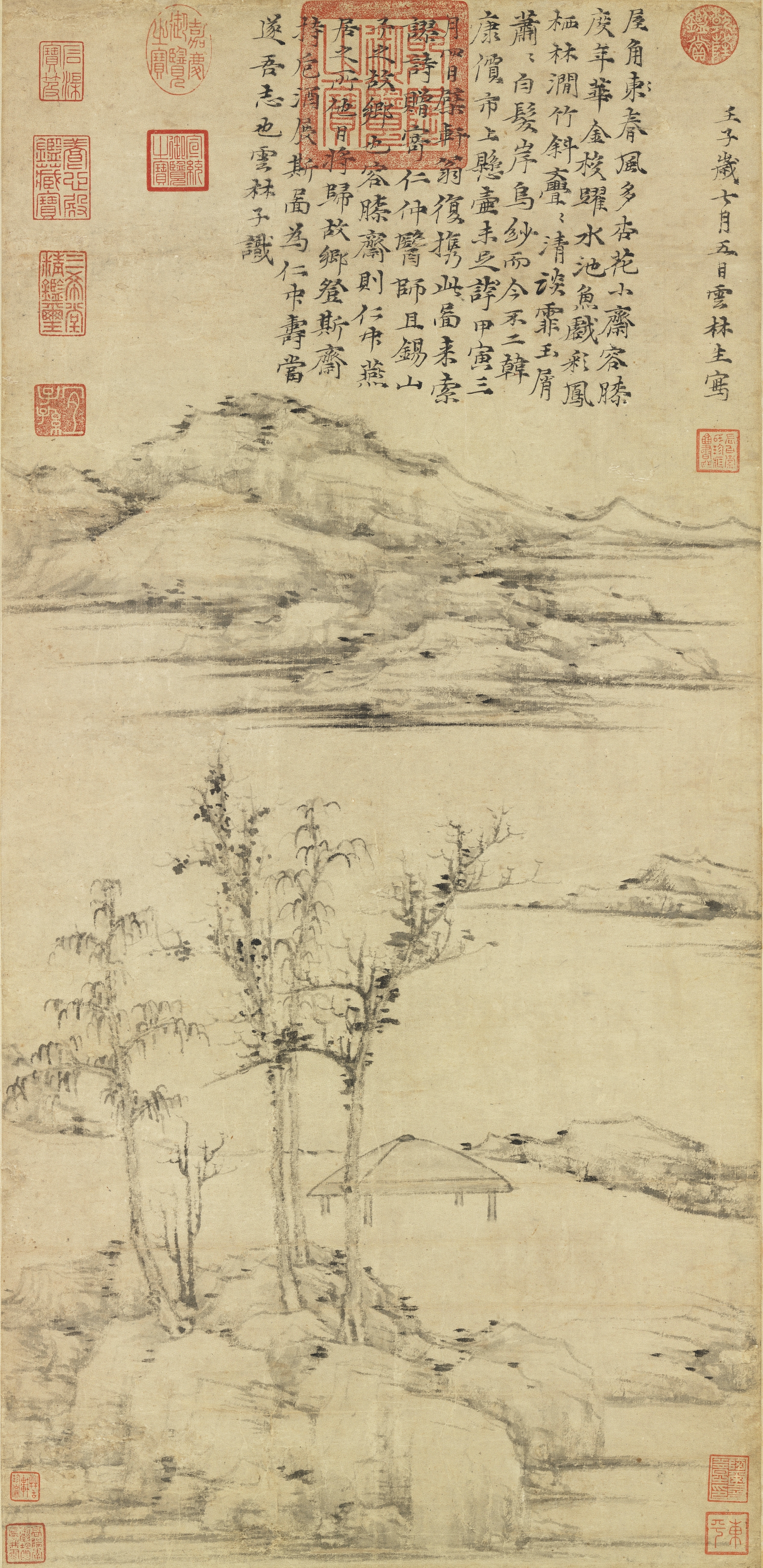
The Rongxi Studio, painted in 1372, two years before Ni Zan's death, reduces Fan Kuan's towering invention to next to nothing: a handful of trees at the edge of a blank stretch of paper standing in for both water and shore. Ni Zan called that reduction, not the cliff, the finished statement.
Dong Qichang Draws a Line Through History
The theory reached its final, most influential form under Dong Qichang (1555 to 1636): a wealthy landowner, high official, collector and painter who was also the most consequential critic of his age. Dong Qichang split the entire history of landscape painting into two schools. His Southern School ran from Wang Wei through the tenth-century masters Dong Yuan and Juran to the Song connoisseur Mi Fu and on to the Yuan masters, Huang Gongwang, Wu Zhen, Ni Zan and Wang Meng: scholars who painted for themselves, without a client. His Northern School collected the trained court professionals, among them the Southern Song court painters Ma Yuan and Xia Gui.
The names came from Chan Buddhism, whose southern branch taught sudden enlightenment and whose northern branch taught a slow, disciplined climb towards it. Dong Qichang borrowed the metaphor for style, not geography, and judged his own Southern School the superior of the two. His landscapes, including Dwelling in the Qingbian Mountains of 1617, were a deliberate continuation of it. The division has shaped how the subject gets taught ever since, even though Dong Qichang built it from his own side of an argument, and his own class.
The Trade They Disdained
The amateur ideal was never quite as clean as its theorists claimed. Zhao Mengfu, a scholar-painter later folded into Dong Qichang's Southern lineage, worked for years as a paid instructor and, by some accounts, relied on assistants to finish work sold under his name. His wife, Guan Daosheng, admired for her ink bamboo, painted Buddhist temple murals on commission. Historians of the period now argue that economically disinterested amateurism was, for most Yuan scholar-painters, an ideal rather than an accurate account of how they lived.
The line between a literatus and a professional was real, but it was drawn as much in rhetoric, in who called whom vulgar, as in anyone's ledger. What survived from a thousand years of that argument was not a clean division of labour. It was a way of painting a mountain nobody had climbed, and insisting that this was the only mountain worth painting.


