Ea subdued Apsû and Mummu, while Marduk later defeated Tiamat and Kingu before dividing Tiamat’s body to form heaven and earth. He ordered the skies, weather, time, stars, earth, gods, and humanity, then made Babylon the gods’ first city and centre.
Marduk’s Rise, Victory, and Creation of the Cosmos
Ea poured sleep over Apsû, bound him, and killed him. He confined Mummu and kept him under control. Ea established his dwelling on Apsû, named it Apsû, and appointed its shrines. Ea and Damkina lived there in splendour, in the chamber of the destinies and the room of the archetypes. The Enūma Eliš then recounts Marduk’s rise to kingship. Marduk defeated Tiamat and Kingu, overcoming the forces opposed to him. After the battle, he surveyed Tiamat’s corpse and divided it by a planned design. He split her in two, like a dried fish. He raised one half and stretched it out as the heavens. He fixed the skin in place and appointed a watch so that her waters could not escape. Marduk crossed the heavens and arranged their celestial parts. He adjusted them to match the Apsû, the dwelling of Nudimmud, and measured the shape of the Apsû. He built Ešarra as a replica of Ešgalla. From Tiamat’s spittle he formed clouds, then appointed the winds, violent rainstorms, and billowing mist. He organised the day, the year, the watches of night and day, and the movements of the heavenly bodies. He organised the earth and the pantheon. He created humanity and gave the gods an ordered cosmos in which to dwell. He established Babylon as the first city and the centre of the gods.
Marduk’s Ordeal
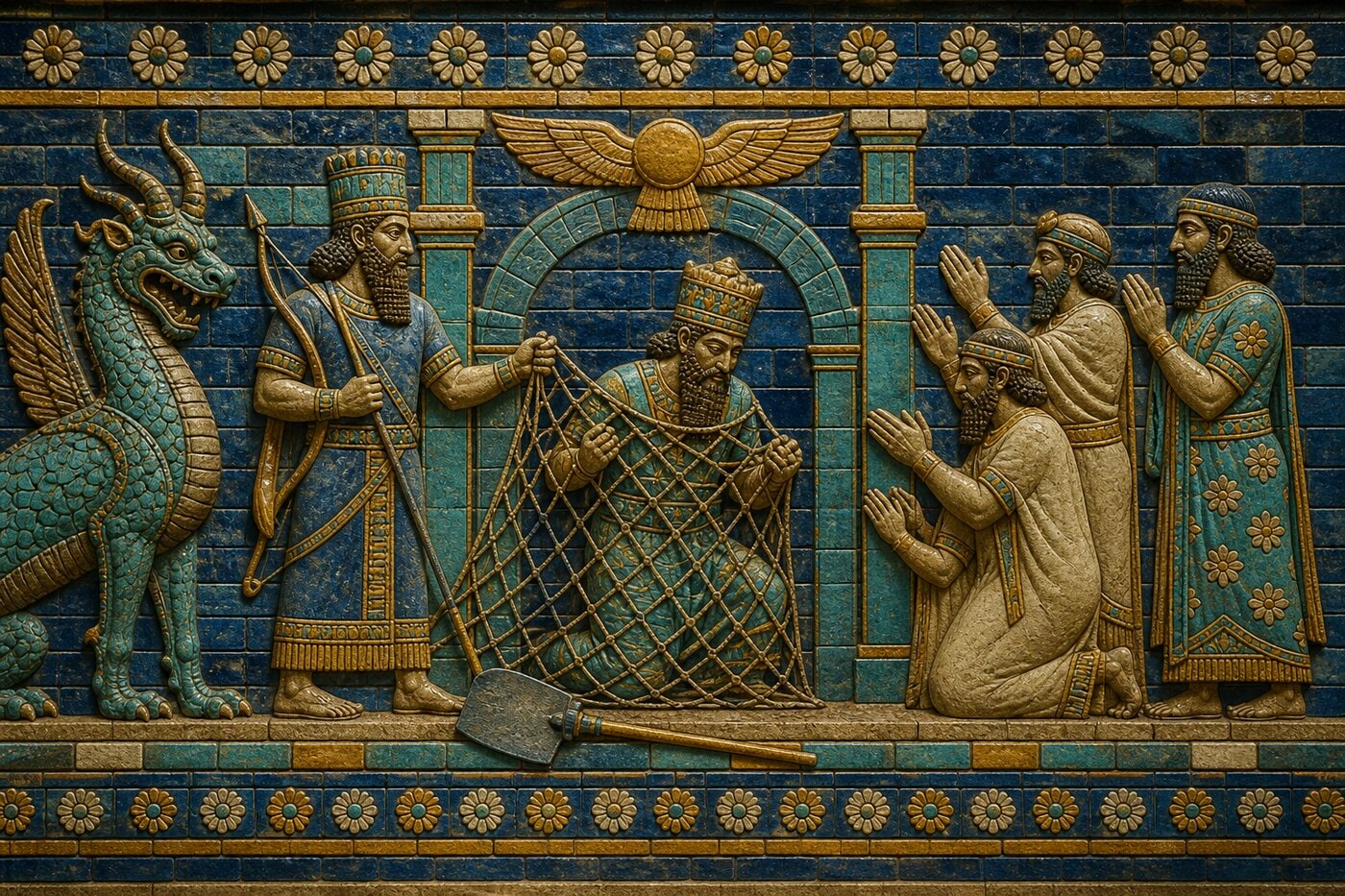
Marduk grew exasperated with the existing divine government and resolved to overthrow it. At that point, his plan and its immediate result were lost. In one telling, the gods later gathered under Enlil’s leadership, at Anu’s command, and came before the lord of the land. They raised a lament for Babylon, and the Babylonians’ grief disturbed Marduk’s sleep.
The gods wept for Babylon. After much weeping, they reached a decision, but the story gave no account of what they decided. Its direct consequence was therefore uncertain. Babylon may have been freed from hard labour and given a privileged place in the universe, but no scene showed how this happened. No event showed Marduk seized, confined, killed, restored, or sought by other gods.
Another tale placed Marduk before Enmešarra and his sons after Nergal brought the prisoners from the jail. Marduk denounced Enmešarra for his offence, then beheaded the seven sons and portrayed them on a wall. He next turned to Enmešarra. Enmešarra’s rays were taken from him and given to Šamaš, and Marduk placed Enmešarra’s depiction on his own dwelling. The account gave no clear statement of Enmešarra’s execution, and it did not describe a seizure, confinement, death, recovery, or return of Marduk. The wider creation cycle also included conflicts, the organisation of the universe, the splitting of heaven and earth, the ordering of the heavens and earth, and Babylon as the first city, but none of those events completed Marduk’s ordeal.