


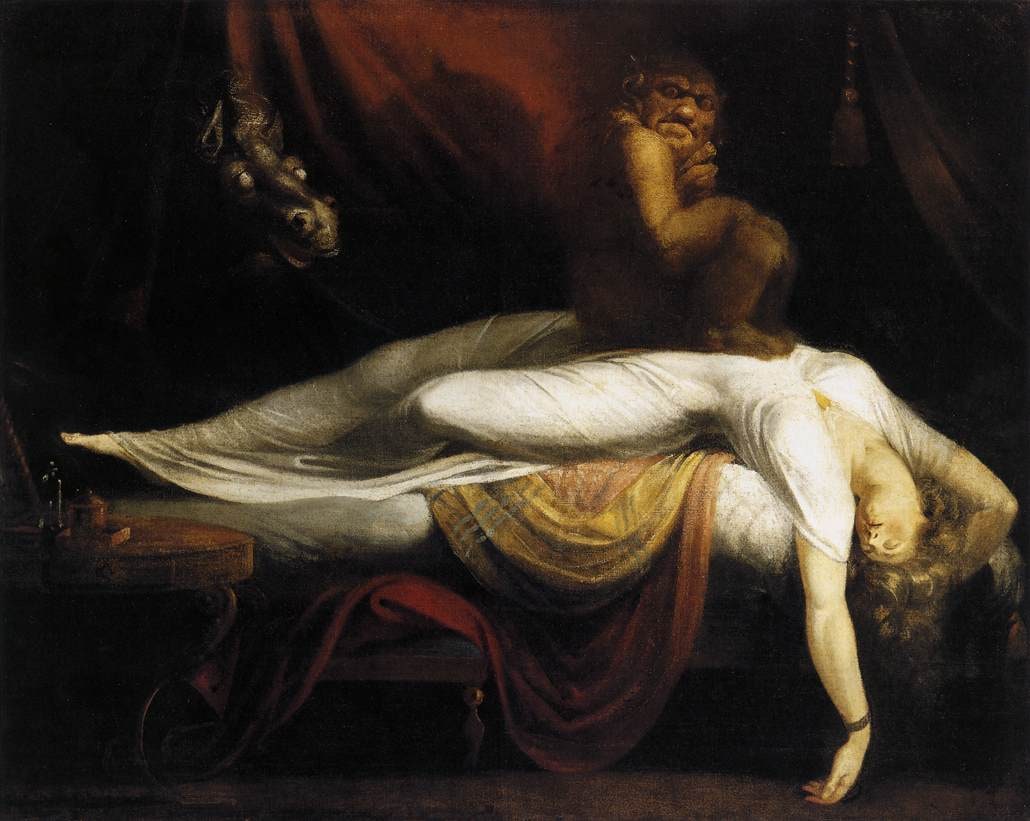
In 1781, Swiss painter Henry Fuseli created The Nightmare, a canvas depicting a sleeping woman draped over a bed as a demonic creature squats upon her torso. The work combines Northern folklore, Renaissance medical theories, and personal grief to give visual form to human terror.
Visualising the Unconscious Mind
Henry Fuseli painted a bad dream by uniting three distinct levels of reality within a single picture plane. A young woman slumps across a bed, her head and arms dangling toward the floor in total surrender to sleep. On her torso sits an incubus, a squatting demon depicted with dark, heavy features. Behind a red curtain in the background, a pale spectral horse with glowing, wide eyes forces its head into the bedroom.
This composition allows the viewer to examine the sleeping figure, the external demon causing her torment, and the bizarre dream vision simultaneously. Fuseli used stark lighting to draw attention to the white nightgown and pale skin of the woman. This bright central element contrasts directly with the shadowy environment and the dark figures invading her space. The woman's open posture suggests vulnerability, while her facial expression indicates subconscious distress.
By arranging these elements together, Fuseli captured the psychological experience of severe sleep paralysis. The heavy posture of the incubus visualises the suffocating chest weight that sleeping victims often report during bad dreams. Rather than presenting a clear moral narrative, Fuseli focused entirely on the internal mood of dread, making the painting an early visual study of the human subconscious.
Mythological and Etymological Origins
The title The Nightmare refers directly to European folklore rather than acting as a simple wordplay on the horse in the background. The English word nightmare derives from the Old English maere and the Teutonic word mara. In Northern European myth, a mara was a malevolent nocturnal spirit that visited sleeping individuals, crouching upon their chests to induce terror and physical suffocation.
In classical antiquity, similar nocturnal spirits were known as an ephialtes in Greek or an incubus in Latin. These entities were thought to torment sleeping women, often with erotic overtones. During the Renaissance, the Swiss physician Paracelsus incorporated these creatures into a formal classification system of imaginary beings, positioning incubi as male spirits targeting female dreamers and succubi as female spirits targeting men.
Fuseli drew directly upon these historical traditions to construct the iconographic details of his canvas. By bringing the incubus out of medieval folklore and placing it in an eighteenth-century domestic bedroom, he bridged ancient folklore and modern psychological representation. The presence of the demon gave tangible form to fears that had previously existed only in stories and medical treatises.
Rejection and the Hidden Portrait
Beyond its reliance on folklore, The Nightmare carries strong connections to Fuseli's personal life. In 1779, while travelling through Zurich on his way to London, Fuseli fell in love with Anna Landoldt. She was the niece of his close friend, the Swiss physiognomist Johann Caspar Lavater. Fuseli proposed marriage to her, but her parents rejected his suit, and she married another man shortly after.
The physical canvas of the painting reveals a direct link to this rejected proposal. On the reverse side of The Nightmare, Fuseli painted an unfinished portrait of a young woman, identified by scholars as Anna Landoldt. The proximity of her portrait to the demonic composition on the front suggests that Fuseli's personal grief and sexual frustration informed the creation of the work.
Some art historians argue that the leering horse thrusting through the curtain or the demon squatting on the sleeper represents the artist's own troubled emotional state. Fuseli painted four distinct versions of The Nightmare throughout his career, indicating a persistent interest in the theme. The repetition of the subject demonstrates how deeply the imagery resonated with both the painter and his contemporary audience.
Classical Rejection and Italian Mannerism
Fuseli was largely self-taught as a painter, having initially trained for the ministry in Switzerland. After moving to London in 1764, he travelled to Rome in 1770 to study art firsthand, remaining in Italy for eight years. While in Rome, Fuseli became the central figure in a circle of British and Swedish artists who sought new forms of artistic expression.
During his time in Italy, Fuseli rejected the Neoclassical doctrines promoted by Johann Joachim Winckelmann. Winckelmann praised the calm grandeur and idealised harmony of ancient Greek sculpture. Fuseli found this approach rigid and emotionally cold. Instead, he turned his attention to the muscular, contorted figures painted by Michelangelo on the ceiling and back wall of the Sistine Chapel.
Fuseli also studied the exaggerated anatomies and unnatural proportions of Italian Mannerist masters such as Parmigianino and Rosso Fiorentino. These Mannerist influences shaped Fuseli's approach to human anatomy. He adopted elongated limbs, dramatic foreshortening, and intense lighting to heighten the emotional charge of his paintings, discarding Neoclassical balance in favour of dark theatricality.
Literary Dark Fantasy and Romanticism
Upon returning to London in 1779, Fuseli established himself by painting scenes from literature that emphasized horror, passion, and madness. Rather than choosing moral stories from Roman history, he selected dramatic episodes from Homer, William Shakespeare, John Milton, and Spenser. He also painted scenes from the Gaelic epics of Ossian, which enjoyed widespread popularity across Europe at the time.
Fuseli's preference for dark themes influenced British art in the late eighteenth century. His paintings often depicted physical agony, demonic encounters, and psychological conflict. In works such as Thor Battering the Midgard Serpent or his depictions of Milton's Satan, Fuseli presented figures caught in violent struggles against overwhelming supernatural forces, using explosive brushwork and stark light contrasts.
Fuseli eventually became a full member of the Royal Academy and served as Professor of Painting. His exploration of dark fantasy, medieval myth, and nocturnal terror marked a shift away from Enlightenment rationalism. By giving visual form to bad dreams in The Nightmare, Fuseli helped open the domain of human emotion and subconscious fantasy for the Romantic movement.


