

Giuseppe Vasi
Giuseppe Vasi is often remembered as the master who taught Giovanni Battista Piranesi the craft of etching. While his pupil later pursued theatrical interpretations of ruins, Vasi remained dedicated to a systematic project: documenting every significant building in Rome. Between 1747 and 1761, he published ten volumes containing 240 plates. This large-scale project provided a complete visual record of the city for 18th-century travellers on the Grand Tour.
Biography
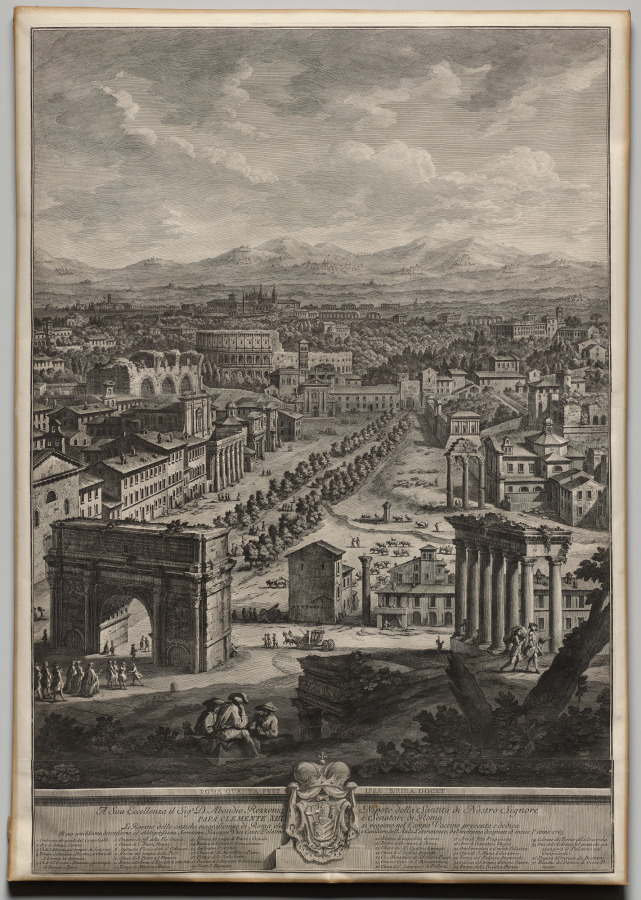
His approach centred on the veduta, or topographical view. Vasi used a precise method to capture the city, often employing multiple perspective points to fit large structures onto a single page. His work, such as the Panorama van de stad Rome, avoided the fantasy of the capriccio in favour of architectural clarity. He focused on the physical reality of the streets and ancient monuments. These etchings functioned as souvenirs for British patrons who wanted to bring a piece of the Roman experience back to their homes.
Modern collectors value these prints for their clean lines and historical accuracy. The monochrome etchings provide a sense of order and classical balance that suits contemporary interiors. Unlike more abstract works, Vasi's views of The Campo Vaccino or the Mausoleum van de Plauzi familie offer a visual record of a specific moment. They provide a clear view of history. The large scale of his panoramas makes them effective for wall displays where architectural detail is appreciated.
Notable Works
Tap to view larger.
Next stop
Browse the movements →
Every movement in the collection, from the Renaissance to Pop art.
Frequently Asked Questions
When was Giuseppe Vasi born?
Giuseppe Vasi was born in 1710 and died in 1782.What is Giuseppe Vasi known for?
Giuseppe Vasi is known for giuseppe Vasi was an 18th-century Italian engraver who documented Rome through precise topographical etchings, serving as a primary teacher to the artist Piranesi.

