

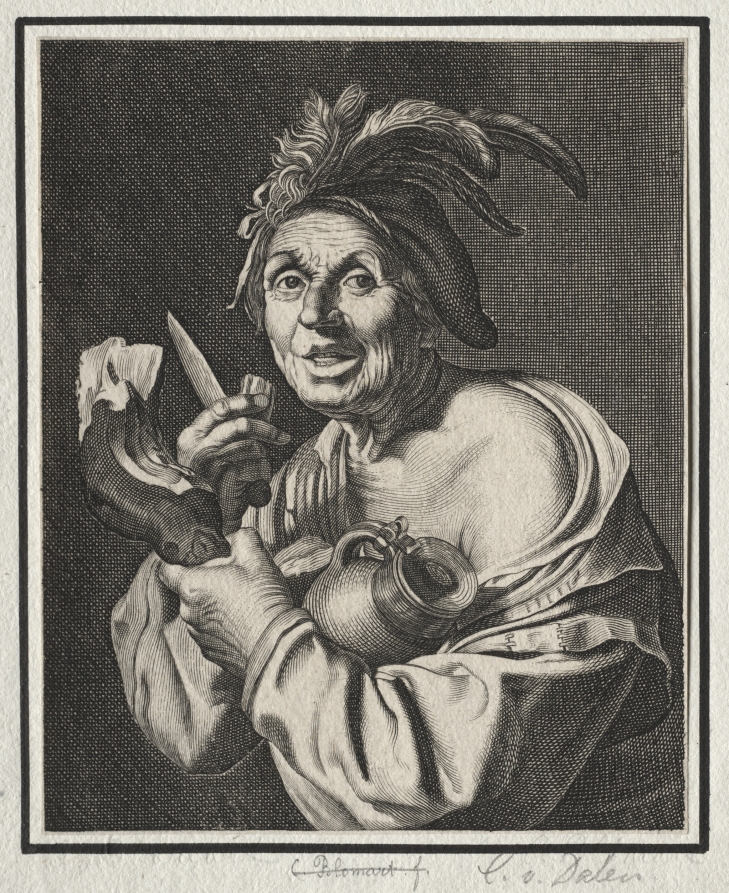


Cornelis van Dalen
Cornelis van Dalen operated a successful printmaking workshop in Amsterdam during the Dutch Republic. While many artists of his era focused on large-scale paintings, Van Dalen found his niche by translating the textures of Dutch life into copperplate engravings. His technical skill allowed him to replicate the appearance of different surfaces, such as the sheen of silk or the moisture of a cured ham. This focus on material reality helped establish the print as a desirable object for the growing middle class.
%2C%20RP-P-1890-A-15920.jpg?width=800)
Biography
The artist used a precise system of cross-hatching to build form and volume. He moved away from the mannered movements and stereotyped faces common in earlier Dutch portraiture. In his genre scenes, Van Dalen captures figures in moments of quiet action. He uses diagonal compositions to create a sense of space without relying on complex architectural backgrounds. His figures often occupy a shallow foreground, which brings the viewer into immediate contact with the subject.
Modern collectors value these prints for their honesty and technical precision. The work provides a direct window into seventeenth-century domestic life without the distraction of heavy symbolism. These pieces suit contemporary interiors because they offer a balance of historical detail and clean composition. The monochromatic nature of the engravings allows them to fit into various colour schemes. They represent a period when art began to celebrate the ordinary.
Notable Works
Tap to view larger.
Next stop
Browse the movements →
Every movement in the collection, from the Renaissance to Pop art.
Related Artists


Frequently Asked Questions
When was Cornelis van Dalen born?
Cornelis van Dalen was born in 1602 and died in 1665.What is Cornelis van Dalen known for?
Cornelis van Dalen is known for cornelis van Dalen was a Dutch Golden Age engraver who used precise technical skill to capture the material textures and domestic realities of the seventeenth century.