


Perseus approached the sleeping Medusa by watching her reflection in Athena’s polished shield, then cut off her head with Hermes’s sickle. He concealed the severed head in a magic wallet and escaped the searching Gorgons because Hades’s helmet made him invisible.
Perseus Beheads Medusa
Perseus set out to find the Gorgons, although no one knew where they lived and no one who had seen Medusa had lived to tell the tale. Athena and Hermes came to his aid. Hermes gave him an adamantine sickle. Athena gave him a brightly polished shield and warned him never to look directly at Medusa. He had to watch her reflection in the shield, or her gaze would turn him to stone.
Athena first led Perseus to Deicterion in Samos. There he saw images of all three Gorgons and learned to distinguish Medusa from her immortal sisters, Stheno and Euryale. Perseus also needed winged sandals, a magic wallet for the severed head, and the dark helmet of invisibility that belonged to Hades. The Stygian nymphs kept these objects, and Perseus obtained them before he reached the Gorgons.
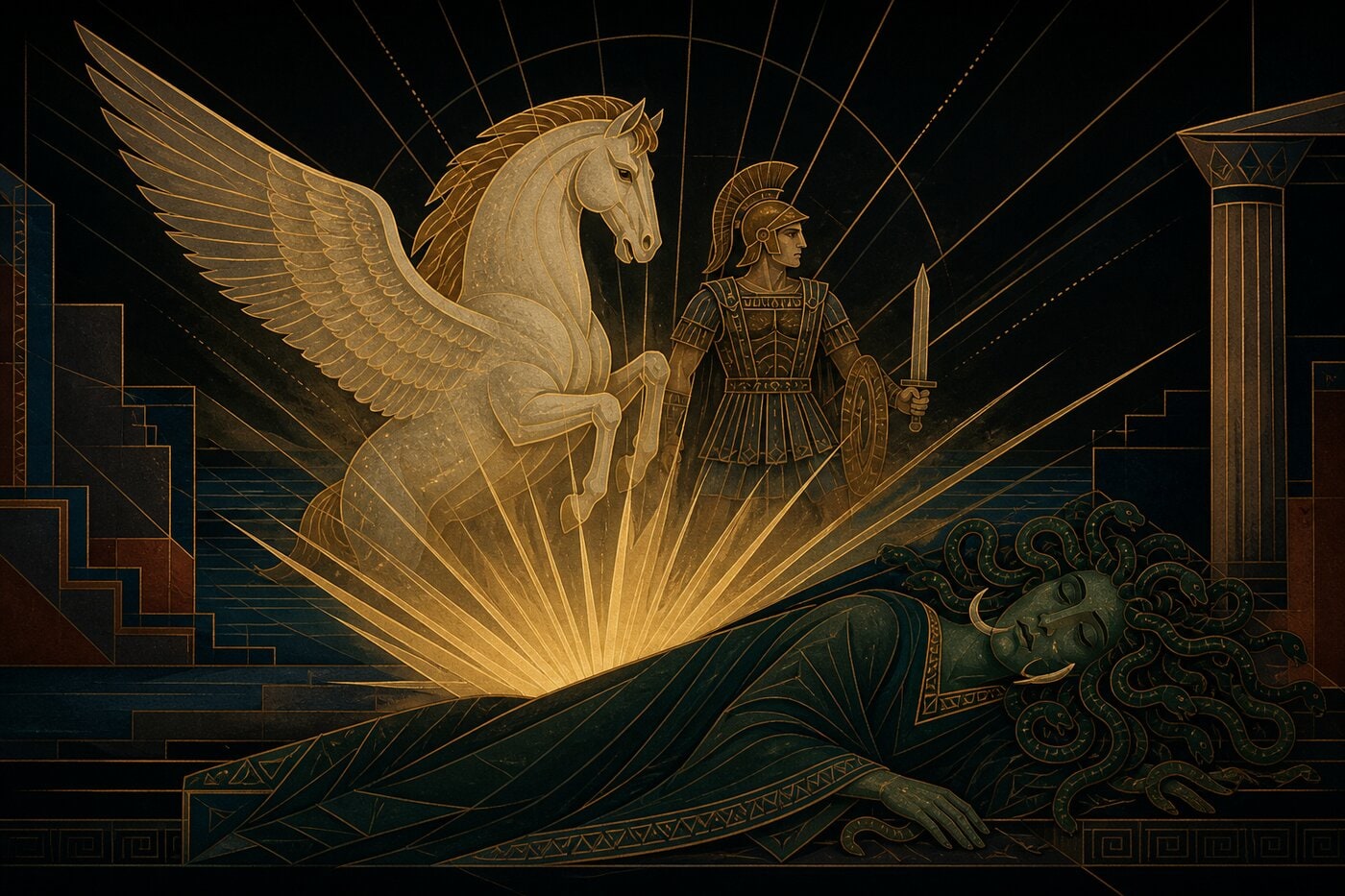
Perseus entered Medusa's lair without meeting her eyes. He watched her reflection in the polished shield and moved towards her while she slept. He raised the sickle and cut off her head. He turned his face away, wrapped the head in the goat-skin attached to the shield, and placed it in the magic wallet. Medusa's sisters then searched for him, but the helmet of invisibility hid him from their sight. Perseus escaped from the lair carrying the Gorgon's head.
Pegasus and Chrysaor Emerge from Medusa
Perseus turned his gaze towards the polished shield and followed Medusa’s reflection. Athena guided his hand. He saw the snakes coiled around her head, writhing and biting one another until blood ran over her forehead. The stench of death weakened him, but he gripped the sickle Hermes had given him and struck. The blade cut through Medusa’s neck, and her head rolled away from her body. Perseus lifted it by the limp snakes and placed it in his wallet.
As Medusa’s blood fell, two beings sprang from her dead body. Pegasus, a magnificent white stallion, emerged with a golden mane, golden hooves, and golden wings. Chrysaor also emerged, fully grown and holding a golden falchion. In another telling, the two rose from the ground where Medusa’s blood had fallen. Poseidon had fathered both of them on Medusa before her death.
Perseus did not challenge Pegasus or Chrysaor. He left quickly with Medusa’s head. Stheno and Euryale woke and pursued him, but the dark helmet of invisibility hid him from their sight. He escaped and flew southwards. At sunset, he landed near the palace of Atlas. Because Atlas had refused him hospitality, Perseus showed him Medusa’s head, and Atlas changed into a mountain. The next day, Perseus flew east across the Libyan desert while Hermes helped him carry the heavy head. He later dropped the Graeae’s eye and tooth into Lake Triton.
Athena Receives Medusa's Head
Athena guided Perseus's hand as he turned away from Medusa and watched her reflection in his polished bronze shield. He cut off her head with one stroke of Hermes's adamantine sickle. Pegasos, the winged horse, and Chrysaor, grasping a golden falchion, sprang from her body. Perseus placed the head in his wallet and fled while Stheno and Euryale rose from sleep and tried to pursue him. Hades's helmet hid him from their sight.
Perseus flew southward and escaped. He showed the head to Atlas, who was changed into a mountain. Hermes helped him carry its weight across the Libyan desert. Perseus later returned to Seriphos with Andromeda and found Danaé and Dictys sheltering in a temple from Polydectes. He entered the palace while Polydectes feasted with his companions, and announced that he had brought the promised gift.
Athena then took Medusa's head and fixed it to her aegis or shield. The Gorgon's face remained a weapon that turned those who looked upon it to stone. One telling said that the aegis was Medusa's skin, which Athena flayed after Perseus had cut off her head. Another said that Athena had stripped the skin from Pallas, a winged, goatish giant, and made the aegis from it.


