


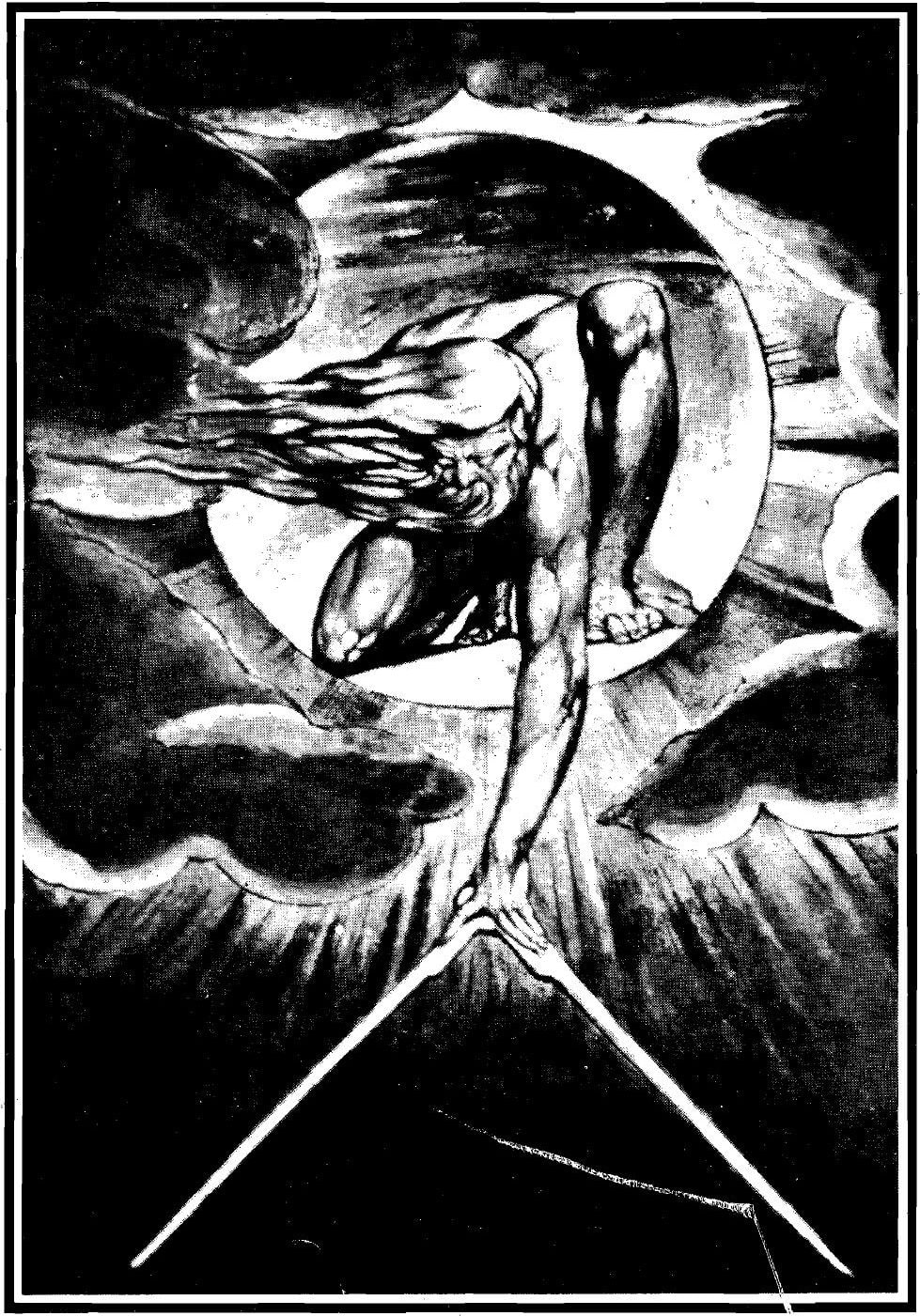
William Blake created The Ancient of Days in 1794 as a relief etching for his illuminated book Europe, a Prophecy. The print depicts Urizen, a mythological figure representing reason, measuring the material universe with a compass out of dark space.
The Vision at Lambeth
William Blake executed The Ancient of Days in 1794 as a relief etching coloured by hand with watercolour. Measuring 23.3 by 16.8 centimetres, the original print resides in the British Museum in London. It functions as the frontispiece to Blake's poem Europe, a Prophecy. The composition shows an old man with white hair reaching down from a glowing yellow orb to measure the dark void below with a wide compass. This act of measuring the universe directly addresses the title's central subject. Blake recorded that he saw this figure in a vivid vision that hovered over his head at the top of a staircase while he was living in Lambeth.
The motif of a divine figure measuring the cosmos connects to a specific biblical source. In the Book of Proverbs, Wisdom describes the creation of the world, noting the moment when the Lord set a compass upon the face of the deep. Compasses symbolising the act of creation had appeared in medieval manuscripts and early Bibles. Blake integrated these historical motifs while drawing visual inspiration from the muscular forms of Michelangelo. However, Blake altered these traditional artistic references to fit his own complex personal mythology.
Urizen and the Four Zoas
Although 'The Ancient of Days' is an Aramaic name for God, Blake did not intend to depict a benevolent biblical creator. The artist was a religious man who disagreed with established Church teachings and despised the official artistic standards of the academies. The figure in the print is Urizen, a character created by Blake to represent a bad demiurgic force. In Blake's personal mythology, Urizen is the creator of the material world. Because Blake viewed the physical world as inherently bad, he considered its creator to be an evil spirit rather than a merciful deity.
Urizen forms part of Blake's concept of the four Zoas, which represent distinct agencies of human selfhood and experience. In this framework, Tharmas represents the physical body, Luvah represents human passion, Urthona represents the creative imagination, and Urizen represents cold reason. Blake believed that balance was necessary among all four agencies. When reason dominates, Urizen takes control, resulting in a state that is territorial and paranoid. In his poetry, Blake described Urizen dividing and measuring space in ninefold darkness, unseen and unknown.
The print captures the nightmare character of Urizen's dominion over the physical realm. The compass reaches into the blackness like a flash of lightning on a dark and stormy night. Under Urizen's rule, the human body and its senses become restricted, emotional passions are inhibited, and the creative imagination is impoverished. Blake portrayed this act of measurement as an act of limitation that trapped humanity within material boundaries rather than a divine blessing.
Relief Etching and Artistic Training
Blake produced The Ancient of Days using a specialised process known as relief etching, sometimes referred to as a metal cut. He began developing illuminated books using this technique in 1788. Following the death of his younger brother Robert, Blake stated that Robert's spirit visited him in a vision to reveal a secret method for printing both poetry and design on a single metal plate. Blake frequently combined relief etching with tempera, woodcut, monotype, and watercolour, while avoiding oil paints because he felt oils lacked necessary line clarity.
Blake's technical skill rested on years of formal training in London. Born in Golden Square as the son of a businessman, he attended a drawing school in Covent Garden at age ten. At fourteen, he began a seven-year apprenticeship under James Basire, an engraver for the London Society of Antiquaries. In August 1779, Blake was admitted to the Royal Academy, where he learned to draw from antique casts, live models, and corpses. However, his radical opinions regarding art frequently clashed with the tutors at the Academy.
Opposing Newtonian Science
Blake strongly opposed Sir Isaac Newton and the rationalist scientific philosophy of his era. He believed that the Age of Reason produced a restricted worldview that reduced human experience to mathematical calculation. By showing Urizen using giant calipers to measure off space, Blake criticised the Newtonian conception of reality. The image contrasts the infinite nature of spiritual vision against the rigid boundaries of scientific measurement.
In executing his designs, Blake refused to draw directly from physical life, choosing to rely entirely on his inner eye. He consciously revolted against the accepted standards of academic representation, paying little attention to conventional rules of anatomy or perspective. Like medieval artists before him, Blake considered the spiritual significance of his inner visions to be far more important than mere technical correctness. This unconventional approach led many of his contemporaries to view his artworks with confusion or hostility.
Commercial Hardship and Isolation
Blake struggled financially throughout his adult life, paying his way primarily through commercial engravings for booksellers such as Joseph Johnson. In 1784, Blake opened a print shop, but the business failed within two years, forcing him back into freelance work for Johnson. Following the French Revolution in 1789, Blake's art and poetry grew increasingly radical. In 1800, the writer William Hayley invited Blake to live on his estate in Sussex. Although initially delighted by the countryside, Blake grew tired of trivial commissions from local society and returned to London in 1803.
Success remained elusive after his return to London. In 1809, Blake staged a private exhibition of his paintings in his brother's hosiery shop, but the show was mocked, and one reviewer described Blake as an unfortunate lunatic. By 1810, he was impoverished and alienated from many friends and patrons. Only a few contemporaries recognised his artistic talent and purchased his relief etchings, saving him from total starvation. As Blake turned sixty, younger artists finally began to admire his work, long after he completed his illustration of Urizen measuring the universe.


.jpg)