


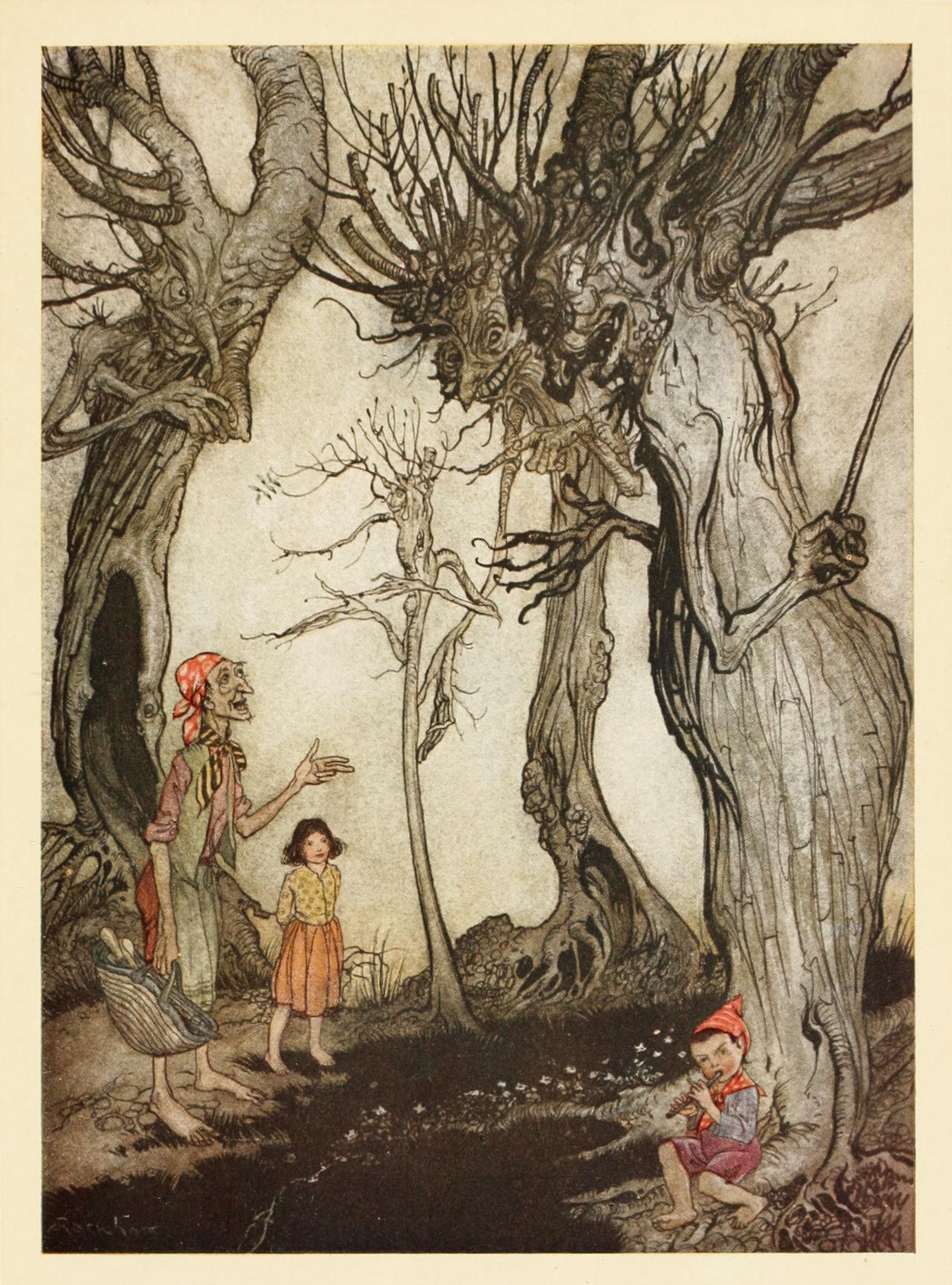
Arthur Rackham's approach to transforming a tree into an expressive character relies on draughtsmanship principles developed by historical master artists. Giving a tree individual character requires rendering muscular bark growth, wayward branch curvatures, and observed natural textures rather than applying rigid compositional rules.
Muscular Trunk and Anatomical Growth
A drawn tree achieves individual character when an artist records its physical structure instead of relying on generic shapes. In his studies of tree stems, John Ruskin examined Albrecht Dürer’s engraving of Adam and Eve as a prime example of factual draughtsmanship. Dürer rendered the wrinkles of bark, smooth wood emerging beneath, and the anatomy of growth at the root of an apple tree. Every line in that drawing contributes directly to facts of natural structure, showing how timber anchors itself into the soil.
This anatomical approach requires depicting the internal muscular forces of the trunk. Stripping a pine trunk of its bark reveals wood fissured along its grain in precise directions. At the point where a bough joins the main trunk, the wood displays contortions similar to human muscle. Dürer and Rembrandt rendered woody texture with notable accuracy, though both artists sometimes missed the sweeping grace of larger lines. Capturing character in a trunk demands depicting these muscular junctions where boughs gather themselves out of the stem.
The Principle of Unexpectedness in Boughs
Character in foliage and timber depends heavily on what Ruskin termed the character of unexpectedness. A drawn bough appears dead if it follows predictable angles or symmetrical curves. J.M.W. Turner demonstrated this principle by drawing boughs that shoot outward like a letter Y with a straight branch, only to correct that stiffness with a zigzag behind it. Boughs that seem awkward individually create unified forms when drawn together, surprising the viewer through subtle variations in line.
These curves waver perpetually along every edge, resembling the finished structure of a fine musical melody. The lines used by Turner appear straight at first glance, but long observation reveals tremulous movements along their edges. A bough never achieves true character unless it appears wayward, seeming quiet initially before revealing unexpected turns. By mastering this waywardness, an artist transforms a static outline into an organic entity with its own distinct rhythm.
Natural Curves versus Artificial Rules
Unimaginative artists fail to give character to trees because they rely on mechanical rules and received formulas of composition. When an artist without direct observation draws a tree, he sets down a serpentine form for the trunk simply to avoid straightness. He attaches branches according to artificial rules, making three or four boughs start from points one above another at unequal distances. He bends one branch downward while three go up, forcing two to cross to create forced contrast.
This reliance on rules produces lifeless patterns rather than convincing timber. Titian frequently fell into a different error, drawing tree trunks with flaccidity that made them resemble flexible seaweed. His habit of drawing the human figure led him to introduce soft animal curves into wood. Real timber possesses a stiffness and spring that separates it completely from animal forms. The subtle curvature of a branch lies within the thickness of a pencil line, defying easy recollection or systematic invention.
Surface Movement and Foliage Structure
Setting a tree in motion requires an understanding of how foliage accumulates and branches ramify in space. In his painting of Saint George, Albrecht Altdorfer used a brush technique that captures the natural disorder of leaves. He laid light strokes over a dark ground to establish the body of a branch, reflecting how outer leaves catch light first while screening inner depths. Younger shoots at branch tips appear brighter than older growth behind them, establishing a sense of continuous development.
Altdorfer allowed this surface chatter of leaves to become the organizing principle of his entire composition. Slender trunks emerge on the left, a thicker trunk gleams near the centre, and other stems disappear into a swarm of green. Some branches grow straight upward, others drift laterally, and others convulse in all directions at once. Because trees possess a repetitive structure, an artist can use these multiplying units to set the whole plant into motion across the picture surface.
Added Knowledge and True Finish
A tree becomes a fully realized character only when an artist adds specific physical details derived from close observation. Turner achieved complete finish in his drawing of ash trunks at Bolton Abbey by adding observed facts. He recorded the texture of bark, the anatomy of muscle beneath, reflected lights in recessed hollows, dark moss stains, and flickering shadows cast by foliage above. He described this process of finishing a picture as carrying the work forward through added truth.
By contrast, John Constable failed to distinguish between moss and shadow in his drawing of Helmingham Park. His central dark touches confused surface stains with the shaded side of the trunk, producing vague brush sweeps without cast shadows or underlying anatomy. Adding dark tones without anatomical knowledge merely blackens a drawing. True finish requires building character through verified facts of growth rather than darkening shadows to conceal ignorance.
Printmaking and Line Precision
Translating the character of trees into prints requires preserving the precise relationships of light and bough arrangement. In Turner's tree drawings, such as those in his Liber Studiorum series including Cephalus and Procris or Hedging and Ditching, woody stiffness combines with the inventive grace of upper boughs. Works such as Chain Bridge over the Tees render thickets with exact attention to aerial relations and the play of light among complex boughs.
Poor printmaking destroys these qualities by substituting mechanical cross-hatching for observational knowledge. Engravings produced in the eighteenth century often turned tree trunks into standardized patterns. When Miller engraved Turner's Modern Italy, he preserved the specific contours of foreground trunks, whereas Meulemeester's engraving after Raphael reduced tree stems to arbitrary lines. Correct draughtsmanship in print requires maintaining the unique direction of bark peeling and the subtle spring of woody curves.


