


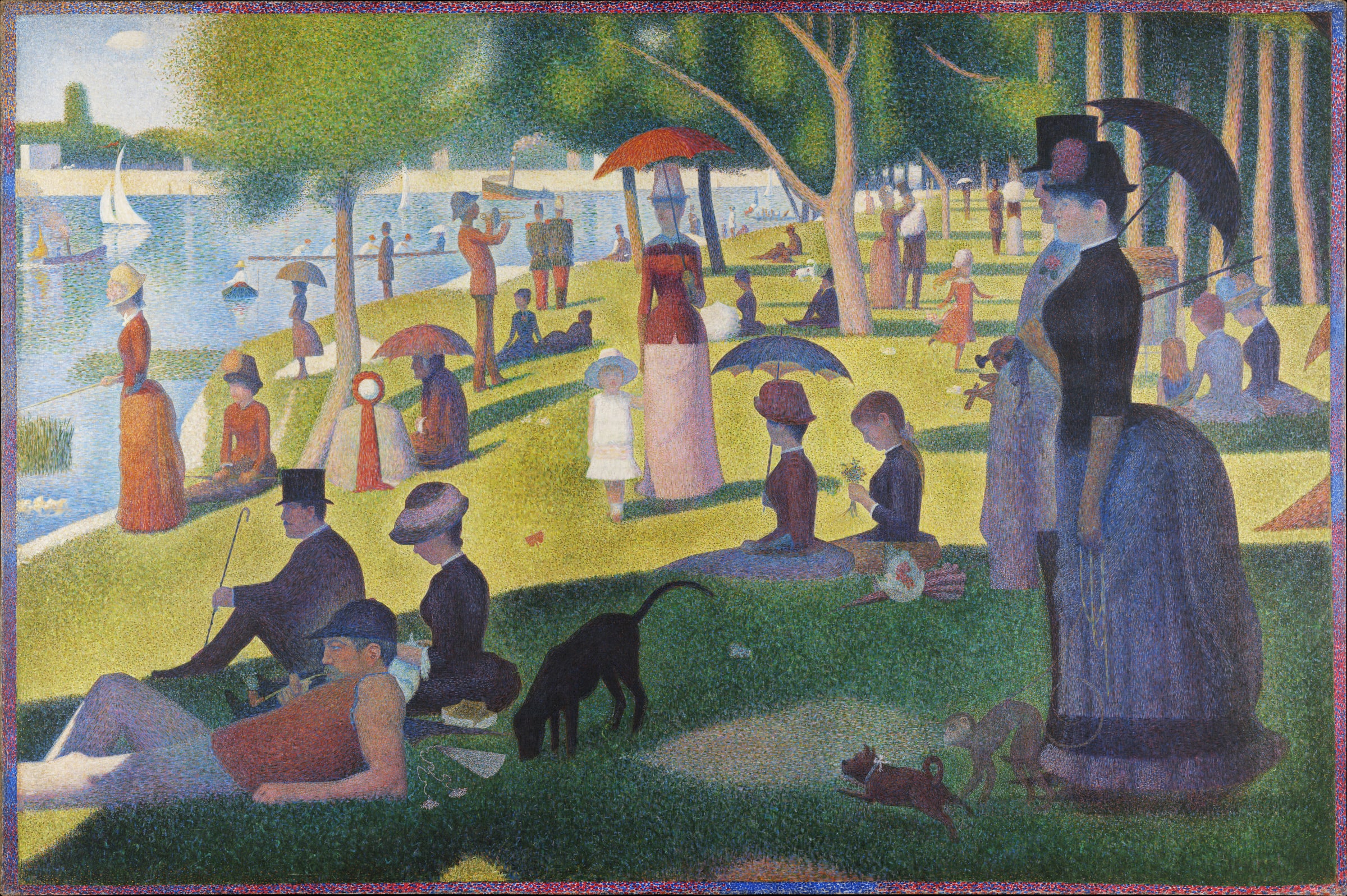
In A Sunday Afternoon on the Island of La Grande Jatte, Georges Seurat applied tiny, distinct dots of pure paint to canvas. When viewed at a distance, these unmixed specks fuse in the viewer's eye to create an optical mixture of light and colour.
Optical Mixing and the View at a Distance
Georges Seurat created A Sunday Afternoon on the Island of La Grande Jatte between 1884 and 1886. Instead of blending pigments on his palette, he applied confetti-sized dots of pure colour directly onto the large canvas. When a spectator stands close to the painting, the individual specks remain visible, giving the surface a grainy and scintillating appearance. When viewed at a distance, these dots appear to fuse together on the retina. Seurat theorised that placing complementary colours side by side produced a higher degree of luminosity than traditional physical mixtures of paint.
The technique became known as pointillism. Seurat used dots of varying scale and shape, orienting them in different directions to describe forms and contours across the canvas. Placed closely together, dots of contrasting hues produced a shimmering effect of light. In La Grande Jatte, which measures 207.6 centimetres by 308 centimetres, this optical method created an illusion of translucent atmosphere. Although the individual specks never merge entirely into a flat tone, the viewer perceives a unified image composed of thousands of discrete applications of paint.
Scientific Principles and Colour Theory
Seurat based his method on scientific studies of light and human perception published during the nineteenth century. He studied Michel-Eugène Chevreul's 1839 text On the Law of Simultaneous Contrast of Colors, alongside Ogden Rood's 1879 physics study Modern Chromatics. He also drew upon Charles Henry's 1885 work, Introduction to a Scientific Aesthetics. These publications replaced earlier Romantic ideas with empirical analyses of optics. Seurat paired complementary hues such as red and green, blue and orange, and yellow and violet to generate a sense of optical vibration on the retina.
The critic Félix Fénéon observed that the optical mixture formed in the eye possessed a luminous intensity greater than any physical blend of pigments on a palette. Fénéon argued that Seurat bridged art and science, elevating objective reality into a sublimated form. Edgar Degas nicknamed the meticulous young artist the notary because Seurat wore a top hat, a dark suit, and precisely pressed trousers. Seurat rejected artistic sentimentality, famously stating that he simply applied his method without seeking poetic interpretation.
Preparatory Studies and Studio Composition
To execute his large canvas, Seurat conducted extensive field research on the island of La Grande Jatte, a popular leisure site situated in the River Seine north-west of Paris. He visited the island daily for six months, producing preparatory drawings of the site and sketching numerous individual figures. He completed forty preliminary colour studies before assembling the final composition inside his studio. This rigorous preparation allowed him to retain the bright colours of open-air Impressionism while imposing a structured design based on geometric forms.
Because this method required exceptional labour and time, Seurat completed only seven large paintings during his decade-long career. His preparation for La Grande Jatte required two full years of work. The finished canvas combines careful calculations of spatial alignment with the bright illumination typical of modern outdoor recreation. The figures are positioned along balanced axes, turning an informal suburban gathering into a permanent arrangement of shapes and shadows.
Figure Composition and the Painted Border
The scene depicts middle-class Parisians relaxing outdoors on a Sunday. A formal couple stands in the shade in their Sunday best, surrounded by dogs, monkeys, running children, women making posies, and working men resting near the water. Seurat painted these figures largely in profile, giving them the rigid quality of a classical frieze. Isolated in pockets of shade, the figures appear silent and static, reflecting the anonymity associated with modern urban existence.
Seurat extended his pointillist technique beyond the main scene by painting a surrounding border directly onto the canvas and frame. He applied red dots alongside green grass on the picture edge, causing the adjacent colours to react optically. While the human figures remain still, the painted atmosphere around them appears active and luminous. Seurat later depicted this work inside his studio painting, The Models, executed between 1887 and 1888, where La Grande Jatte appears on the wall behind three studio models.
Critical Reception and Belgian Influence
When Seurat displayed La Grande Jatte at the final Impressionist exhibition in 1886, the majority of contemporary artists and critics reacted with indignation. Opponents rejected his formal application of paint as rigid and mechanical. In Belgium, where the painting was shown at the exhibition of Les XX, reaction was divided. Madelaine Maus described the encounter as a revelation of absolute newness and clarity, whereas the artist James Ensor rejected the method, stating that pointillists applied their dots coldly between stiff outlines.
Despite hostile reactions from traditionalists, several younger painters adopted the method. Belgian artists such as Willy Finch, Henry van de Velde, Théo van Rysselberghe, and Georges Lemmen incorporated pointillism into their work. Writing in L'Art Moderne in 1888, supporters argued that opposing Neo-Impressionism meant remaining attached to past conventions. Fénéon contrasted Seurat's structured clarity with Impressionist pictures, which he described as summary and approximate in their execution.
Linear Systems and Later Works
After 1886, Seurat expanded his quasiscientific approach to include linear direction and emotional expression. He assigned specific psychological effects to deliberate combinations of colour and line. Warm orange and red hues paired with upward-moving lines were intended to evoke gaiety and action. Dark blue and green colours combined with descending lines produced feelings of sadness. Balanced middle tones and horizontal lines were designed to convey stability and calm.
Seurat applied these theories in his final canvas, Le Cirque, painted in 1891. He used acid yellows, bright oranges, and upward curves to depict active circus performers, contrasting them against static rows of spectators seated horizontally. Seurat died of a severe infection at the age of thirty-two, three days after exhibiting the unfinished work. His death marked the loss of a painter who avoided taking disciples, insisting that wider adoption reduced individual originality.


