

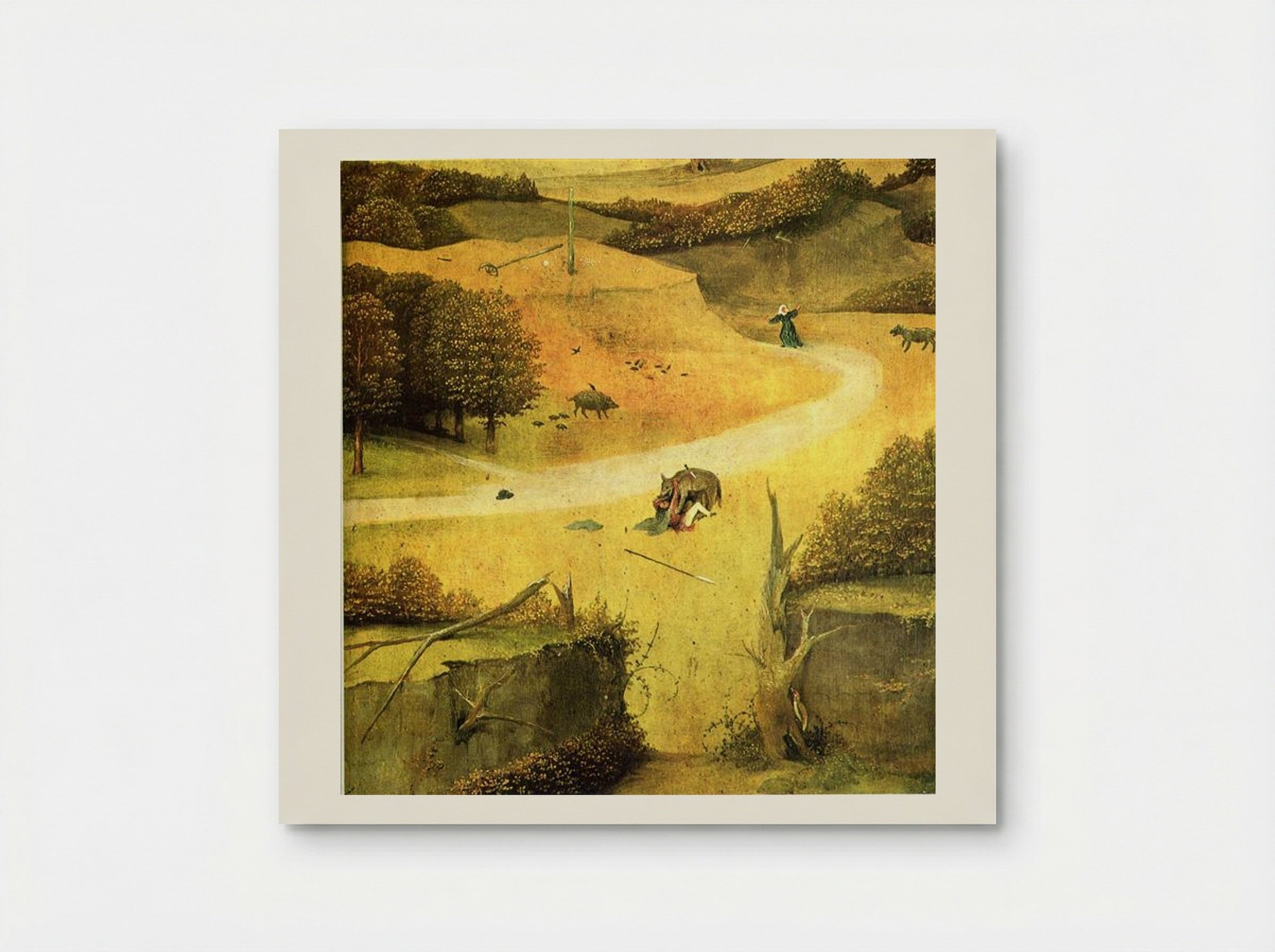
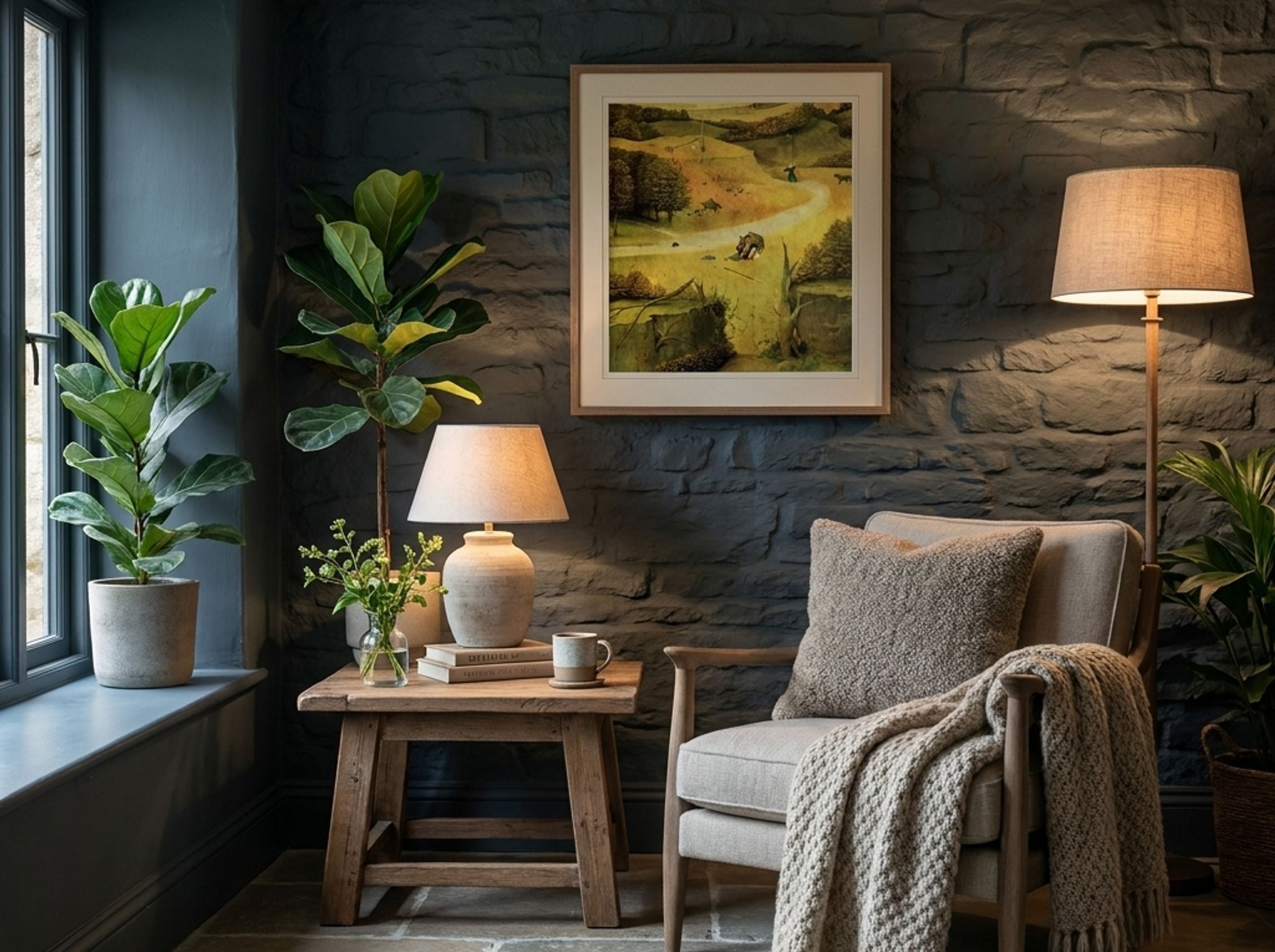
Konungarnas tillbedjan (detalj) - Hieronymus Bosch
Arkivbeständigt giclée-tryck
Ramar levereras klara att hängas upp
Säker utcheckning
Tillverkad på beställning
Beskrivning
En detalj från Hieronymus Boschs "Konungarnas tillbedjan" (ca 1475) visar ett landskap fyllt av symboliska och oroande bilder, karakteristiskt för den tidiga nederländska mästarens unika stil och vision.
Denna detalj från Hieronymus Boschs "Konungarnas tillbedjan" (ca 1475) presenterar en komplex, symbolisk värld. Bosch, en holländsk målare verksam under den tidiga nederländska perioden, är känd för sina fantasifulla och ofta oroande skildringar av religiösa berättelser. Hans verk innehåller ofta inslag av fantasi och moraliska allegorier. Den kompletta triptyken skildrar den bibliska scenen där de tre vise männen besöker Jesusbarnet. Denna detalj fokuserar på bakgrundselementen och avslöjar ett landskap som vimlar av märkliga händelser. Scenen är placerad i en panoramavy av böljande kullar och slingrande stigar. I förgrunden utspelar sig en störande scen: en vargliknande varelse attackerar en mänsklig figur. Längre fram på stigen gestikulerar en kvinna vilt, medan vildsvin strövar fritt. Den övergripande paletten domineras av jordnära gula och gröna färger, vilket skapar en något oroande atmosfär. Boschs noggranna penselarbete och uppmärksamhet på detaljer är tydliga i återgivningen av lövverk, figurer och bisarra händelser. Målningen är inte bara en skildring av en religiös händelse; den är en utforskning av mänsklig natur, moral och ondskans närvaro i världen.
Returpolicy
Eftersom varje tryck görs på beställning erbjuder vi inte returer, återbetalningar eller byten på grund av ändrade åsikter. Om din beställning kommer fram felaktig, skadad eller fel, ersätter vi den kostnadsfritt – kontakta oss bara inom 48 timmar efter leverans. Se vår återbetalningssida för fullständig information.
Frakt
Vi skickar till hela världen och trycker vid den produktionsanläggning som är närmast din leveransadress. Leveranstider och kostnader varierar beroende på destination – du ser tillgängliga alternativ i kassan.
Tillverkning
Varje tryck produceras på beställning med 12-färgs gicléetryck på FSC-certifierat arkivpapper. Designade i Storbritannien och tryckta vid närmaste produktionsanläggning för att minska avfall och snabba upp leveransen.
Konungarnas tillbedjan (detalj) - Hieronymus Bosch

Artist Biography
Hieronymus Bosch
When he was about thirteen, a fire destroyed 4,000 houses in the town. He almost certainly watched it. Scholars point to this event when explaining why flames appear so insistently in his later work, licking across panels of the damned and the disobedient, painted with a specificity that suggests memory rather than imagination.
He came from painters. His grandfather Jan van Aken had been one; four of Jan's five sons were painters too, though none of their work survives. Bosch married Aleyt Goyaerts van den Meervenne, a woman who was older than him and considerably wealthier. Her money meant he did not depend on commissions. He could paint what interested him, and what interested him was the full catalogue of human foolishness.
Only about 25 paintings are confidently attributed to him today. He signed just seven of them and dated none. The Garden of Earthly Delights, his best-known work, is a triptych tracing the arc from paradise to damnation, packed with hundreds of nude figures, hybrid creatures, and objects that resist easy interpretation. In 2014, someone noticed what appeared to be musical notes written on a tortured figure's backside in the hell panel. They transcribed and recorded the result. It sounds roughly as you would expect music from hell to sound.
His technique was unusual for the period. Where his Netherlandish contemporaries built up smooth, translucent glazes that concealed all brushwork, Bosch painted in thin, loose layers. The chalk underdrawing sometimes shows through. The effect is closer to drawing than to the polished surfaces of van Eyck or Memling.
He joined the Brotherhood of Our Lady in the late 1480s, a prestigious local confraternity with about 40 primary members and 7,000 associates across Europe. His father had served as their artistic adviser. The Brotherhood connected him to wealthy, orthodox Catholic patrons, and his paintings were collected across the Netherlands, Austria, and Spain during his lifetime. Philip II of Spain amassed so many that the Prado remains the richest repository of his work. The Surrealists claimed him centuries later. Leonora Carrington called him the first modern artist.
Våra funktioner
Utformad för varaktig inverkan
Specifika funktioner
Varje Solis-konstverk tillverkas på beställning med arkivbeständiga material av gallerikvalitet som är byggda för att hålla.
- Giclée-tryck i museikvalitet för fylliga, blekningsbeständiga färger
- Arkivbeständigt matt konstpapper, FSC-certifierat
- Flera storlekar och inramningsalternativ tillgängliga
- Ramar i svart, naturträ, mörkt trä eller vitt
- Inramade tryck levereras klara att hänga upp
Skötsel & rengöring
För att bevara ditt konstverk i bästa skick:
- Damma försiktigt med en mjuk, torr trasa
- Undvik långvarigt direkt solljus
- Använd aldrig flytande rengöringsmedel på trycket eller dukytan
- Förvara på en torr plats i rumstemperatur
- Hantera tryck med rena, torra händer
Material och storlek
Gicléeutskrift av museikvalitet på FSC-certifierat matt arkivpapper, med inramade alternativ och alternativ på canvas.
- Pappersstorlekar: A4, A3, A2, A1, A0 och B2 (50×70 cm)
- Canvas: XS (20×30 cm) till Large (60×90 cm)
- Ramar: svart, naturligt trä, mörkt trä eller vit
Varför välja oss?
Leveransgaranti utan skador
Snabb leverans
Material av museikvalitet
Artistbiografi
Hieronymus Bosch
When he was about thirteen, a fire destroyed 4,000 houses in the town. He almost certainly watched it. Scholars point to this event when explaining why flames appear so insistently in his later work, licking across panels of the damned and the disobedient, painted with a specificity that suggests memory rather than imagination.
He came from painters. His grandfather Jan van Aken had been one; four of Jan's five sons were painters too, though none of their work survives. Bosch married Aleyt Goyaerts van den Meervenne, a woman who was older than him and considerably wealthier. Her money meant he did not depend on commissions. He could paint what interested him, and what interested him was the full catalogue of human foolishness.
Only about 25 paintings are confidently attributed to him today. He signed just seven of them and dated none. The Garden of Earthly Delights, his best-known work, is a triptych tracing the arc from paradise to damnation, packed with hundreds of nude figures, hybrid creatures, and objects that resist easy interpretation. In 2014, someone noticed what appeared to be musical notes written on a tortured figure's backside in the hell panel. They transcribed and recorded the result. It sounds roughly as you would expect music from hell to sound.
His technique was unusual for the period. Where his Netherlandish contemporaries built up smooth, translucent glazes that concealed all brushwork, Bosch painted in thin, loose layers. The chalk underdrawing sometimes shows through. The effect is closer to drawing than to the polished surfaces of van Eyck or Memling.
He joined the Brotherhood of Our Lady in the late 1480s, a prestigious local confraternity with about 40 primary members and 7,000 associates across Europe. His father had served as their artistic adviser. The Brotherhood connected him to wealthy, orthodox Catholic patrons, and his paintings were collected across the Netherlands, Austria, and Spain during his lifetime. Philip II of Spain amassed so many that the Prado remains the richest repository of his work. The Surrealists claimed him centuries later. Leonora Carrington called him the first modern artist.
Du kanske också gillar