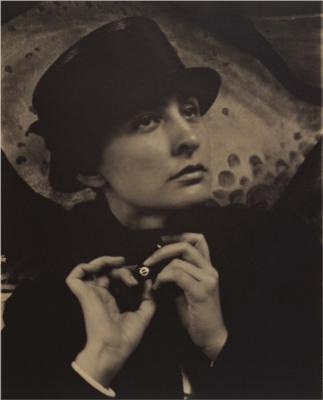
I. Rice Pereira
- Bauhaus
Irene Rice Pereira often signed her work as I. Rice Pereira to navigate the male-dominated art world of the 1930s. While many of her contemporaries focused on traditional canvas, she experimented with industrial materials like glass, parchment, and plastic. She taught at the Design Laboratory in New York, a school established on Bauhaus principles. This institution sought to integrate art with industrial design, a philosophy that shaped her technical approach to composition.

Biography
Her work focuses on the physics of light and space. She utilised layers of semi-transparent materials to create actual depth rather than just the illusion of it. In pieces like White Lines, she uses geometric precision to explore how light interacts with different surfaces. Her method involves a strict mathematical logic. She avoided emotional brushwork in favour of clean, machine-like execution.
Modern collectors value her work for its architectural clarity and neutral palette. Her compositions fit well in contemporary interiors that prioritise structure and light. The use of geometric forms provides a sense of order. Because she worked at the intersection of technology and art, her prints remain relevant in a world where digital precision is common.
Notable Works
Tap to view larger.
Next stop
Browse the movements →
Every movement in the collection, from the Renaissance to Pop art.
Frequently Asked Questions
When was I. Rice Pereira born?
I. Rice Pereira was born in 1902 and died in 1971.What art movement was I. Rice Pereira part of?
I. Rice Pereira was associated with Bauhaus.What is I. Rice Pereira known for?
I. Rice Pereira is known for i. Rice Pereira was an American abstract artist who applied Bauhaus principles to geometric painting and industrial materials to explore the physics of light.


_%E2%80%93_LOC.jpg)