



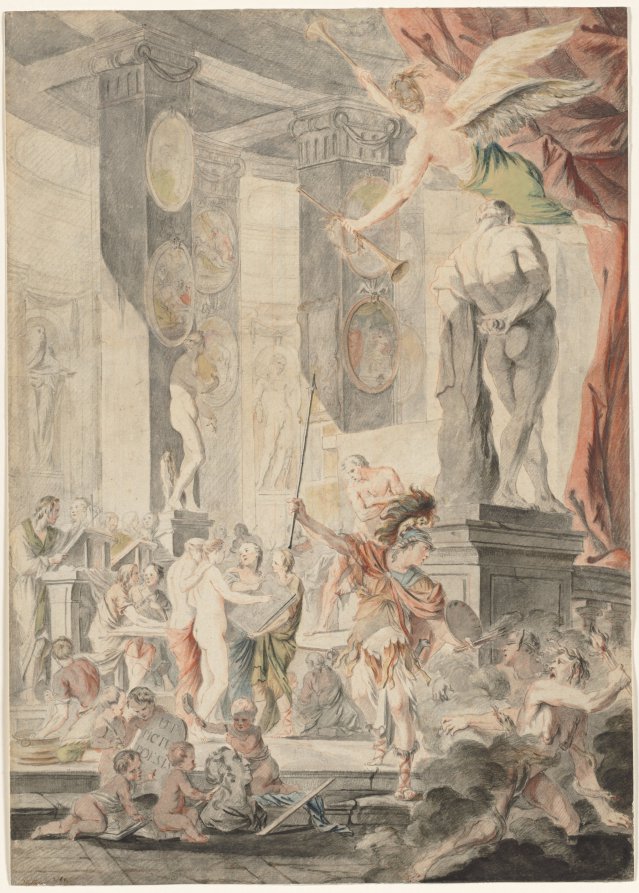


Charles Francois Hutin
Charles Francois Hutin began his career as a sculptor in Paris under the guidance of Sebastien Slodtz. He spent seven years in Rome studying classical forms before returning to France. In 1748, he moved to Dresden at the invitation of the Elector of Saxony. This move defined his career; he eventually became the first director of the Dresden Academy of Fine Arts in 1764.
Biography
Hutin is known for his ability to translate complex compositions into clear, readable forms. He worked extensively on the catalogue of the Dresden Gallery, where he produced engravings based on the collection. This work required a disciplined approach to light and shadow. His paintings, such as Christ Returned to the Father, demonstrate this technical precision. He moved away from the lighthearted themes of the early Rococo toward more serious religious and historical subjects.
Modern collectors value Hutin for his balanced compositions and soft colour palettes. His work provides a sense of quiet dignity that fits well in formal spaces. The academic clarity of his work makes these prints easy to integrate into contemporary interiors. His work offers a connection to the mid-18th-century European court tradition without being overly decorative.
Notable Works
Tap to view larger.
Next stop
Browse the movements →
Every movement in the collection, from the Renaissance to Pop art.
Related Artists


Frequently Asked Questions
When was Charles Francois Hutin born?
Charles Francois Hutin was born in 1715 and died in 1776.What is Charles Francois Hutin known for?
Charles Francois Hutin is known for charles Francois Hutin was a French painter and sculptor who became the first director of the Dresden Academy, known for his precise religious and historical compositions.