


Update 28th August 2026: On 27 August 2026, the Yayoi Kusama Museum and Foundation announced that Yayoi Kusama had died at a hospital in Tokyo on 14 August, aged ninety-seven. Their statement said that she continued to paint until her final days. It is difficult to imagine a more fitting measure of her life: nearly nine decades of making, revising, repeating and imagining, sustained by her belief that art and love could reach beyond the self.[1]
Kusama became a permanent resident of Seiwa Hospital in 1977. That fact is part of her story, but it should never be used to reduce her. Residential care was one element in a working life she shaped with remarkable purpose: a nearby studio, long days of painting, writing in the evenings, and an international career that changed how millions of people experience contemporary art.[2] [5]
Matsumoto and the First Dots
Yayoi Kusama was born in Matsumoto in 1929. Her family ran a seed and plant nursery, surrounding her early life with flowers, pumpkins and repeating organic forms. She later described difficult experiences within her family and vivid visual hallucinations beginning in childhood. Dots, nets and fields of pattern could appear to spread across objects, rooms and her own body. Drawing gave those experiences a form she could work with.[2]
Those visions help explain one source of the dots and nets, but they do not explain the whole of Kusama’s art. Her work grew from observation, craft, ambition, humour, political conviction and an extraordinary capacity to invent. Pumpkins became companions with their own personalities. Nets became vast painted fields. Mirrors became architecture. Repetition became a way to think about the self, the universe and our place within it. To treat all of that as a symptom would be to miss the artist making deliberate choices at every stage.
Kyoto and New York
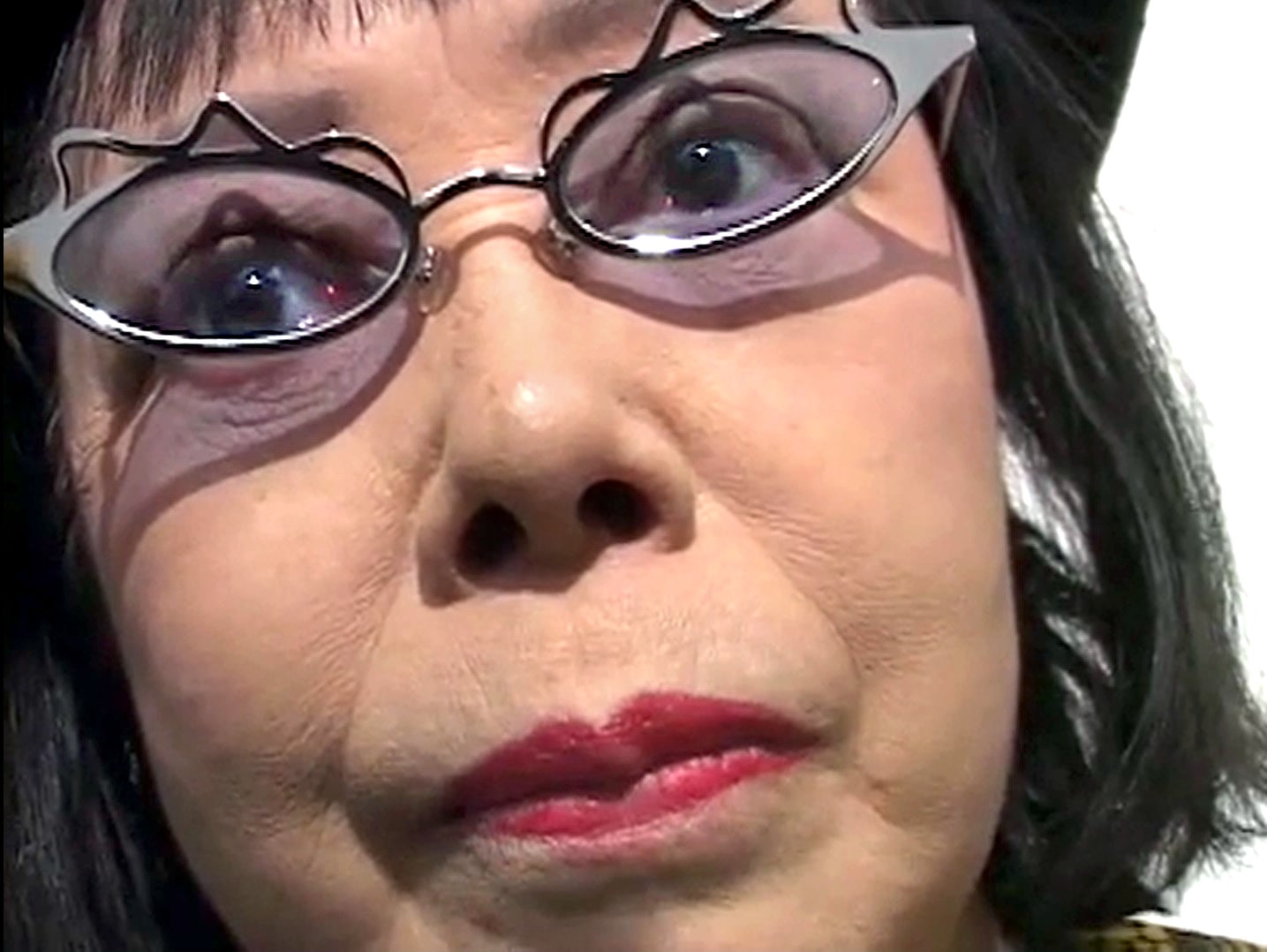
Kusama studied Nihonga painting at the Kyoto Municipal School of Arts and Crafts. She mastered a demanding traditional technique, but its conventions could not contain what she wanted to make. In the 1950s she corresponded with Georgia O’Keeffe, travelled to the United States, and settled in New York in 1958.[2]
There she began the Infinity Nets, canvases built from thousands of small, repeated arcs of paint. Their scale and concentration announced an artist with complete confidence in her own visual language. They were not background pattern. They were paintings about duration, attention and an expanse that appeared to continue beyond the edge of the canvas.[3]
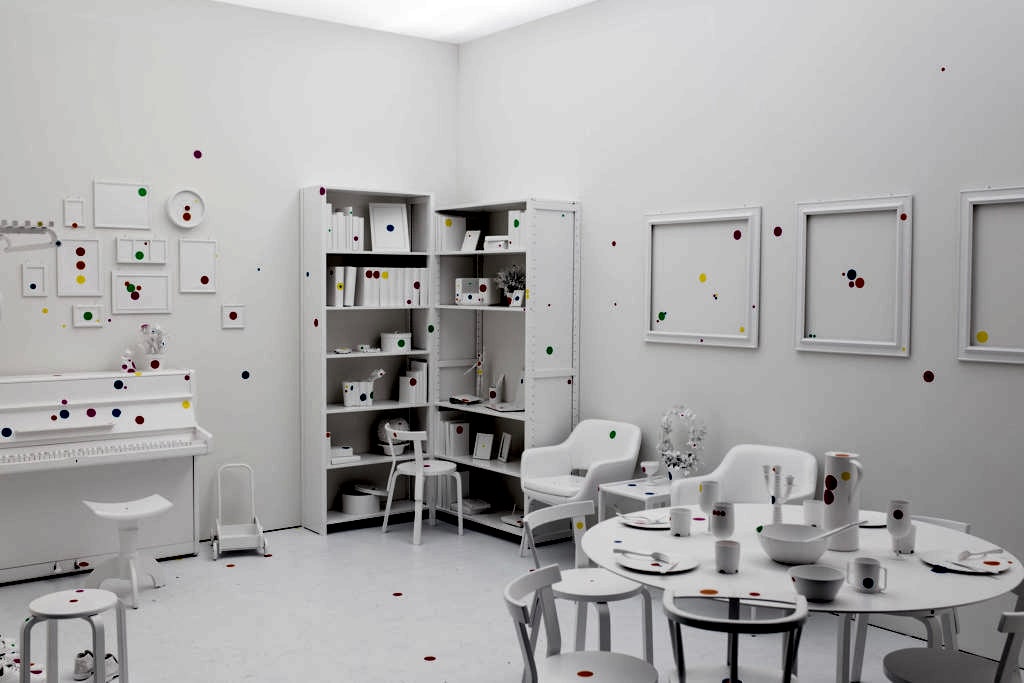
In the early 1960s she extended repetition into sculpture, covering furniture and everyday objects with hand-sewn forms in the Accumulation works. In 1965 she made Infinity Mirror Room: Phalli’s Field, her first mirror environment. Mirrors released repetition from the physical limit of what one person could sew or paint and made the visitor part of the work.[6]
Art in Public
Kusama’s New York practice moved freely between painting, sculpture, installation, film, fashion, publishing and performance. In 1966 she staged Narcissus Garden outside the Venice Biennale, placing hundreds of mirrored spheres on the lawn and offering them for sale. The action was theatrical, funny and pointed: a young Japanese woman artist placed herself at the centre of the international art world while questioning the way that world turned art and reputation into commodities.[4]
Her Happenings later occupied parks and prominent public sites in New York. They joined body painting and polka dots to anti-war protest, sexual freedom and the wider demand for civil rights. This was not an artist retreating from the world. It was an artist using visibility, participation and spectacle to challenge it.[4] [6]
Returning to Tokyo
Kusama returned to Japan in 1973, aged forty-four. The transition was not simple, and the international art world was slow to give her New York work its proper place in postwar history. Yet this period was not an ending. She continued to exhibit, made collages, ceramics and works on paper, and developed a major literary practice.[2]
She was hospitalised at Seiwa Hospital in 1975 and became a permanent resident in March 1977, opening a studio nearby. Her first novel, Manhattan Suicide Addict, appeared in 1978. Her second novel, The Hustler’s Grotto of Christopher Street, won a Japanese award for new writers in 1983. Writing was not an aside to her visual art. Fiction, poetry and autobiography became another part of the world she was building.[2]
A Life Built Around Making
The private details of Kusama’s medical care belong to her. The public record shows something clear and more important: she established a routine that protected her ability to work. The Whitney has described her living in an open ward, travelling to a nearby studio for a full working day and writing in the evening. Within that structure she sustained one of the most prolific late careers in modern art.[5]
The hospital was neither the source of her imagination nor an explanation for her achievement. It was part of the life she chose and organised around the work. The work itself came from discipline, curiosity, visual intelligence and the daily act of returning to the studio.
Infinity, Participation and Love
Kusama’s mirror rooms are sometimes described too narrowly as recreations of her hallucinations. Her visual experiences mattered, particularly to the dots, nets and idea of self-obliteration, but the rooms are carefully composed works of art, not clinical illustrations. Mirrors, light, colour, scale and duration are arranged so that each visitor becomes both viewer and subject.
Across the rooms, Kusama explored the pleasure and unease of losing a fixed sense of self. A body can appear multiplied without end, then vanish into darkness or light. Some rooms are joyful, some quiet, and some confront death and the possibility of an afterlife. Her idea of “Love Forever” also carried the political hopes of the 1960s: civil rights, sexual liberation and opposition to war.[6]
Recognition
The international reappraisal of Kusama gathered strength with a major New York retrospective in 1989. In 1993 she presented a solo exhibition in the Japanese Pavilion at the Venice Biennale. Love Forever: Yayoi Kusama, 1958–1968 opened in Los Angeles in 1998 and travelled to the Museum of Modern Art, the Walker Art Center and the Museum of Contemporary Art Tokyo. A later retrospective travelled through Madrid, Paris and London before reaching the Whitney in 2012.[2]
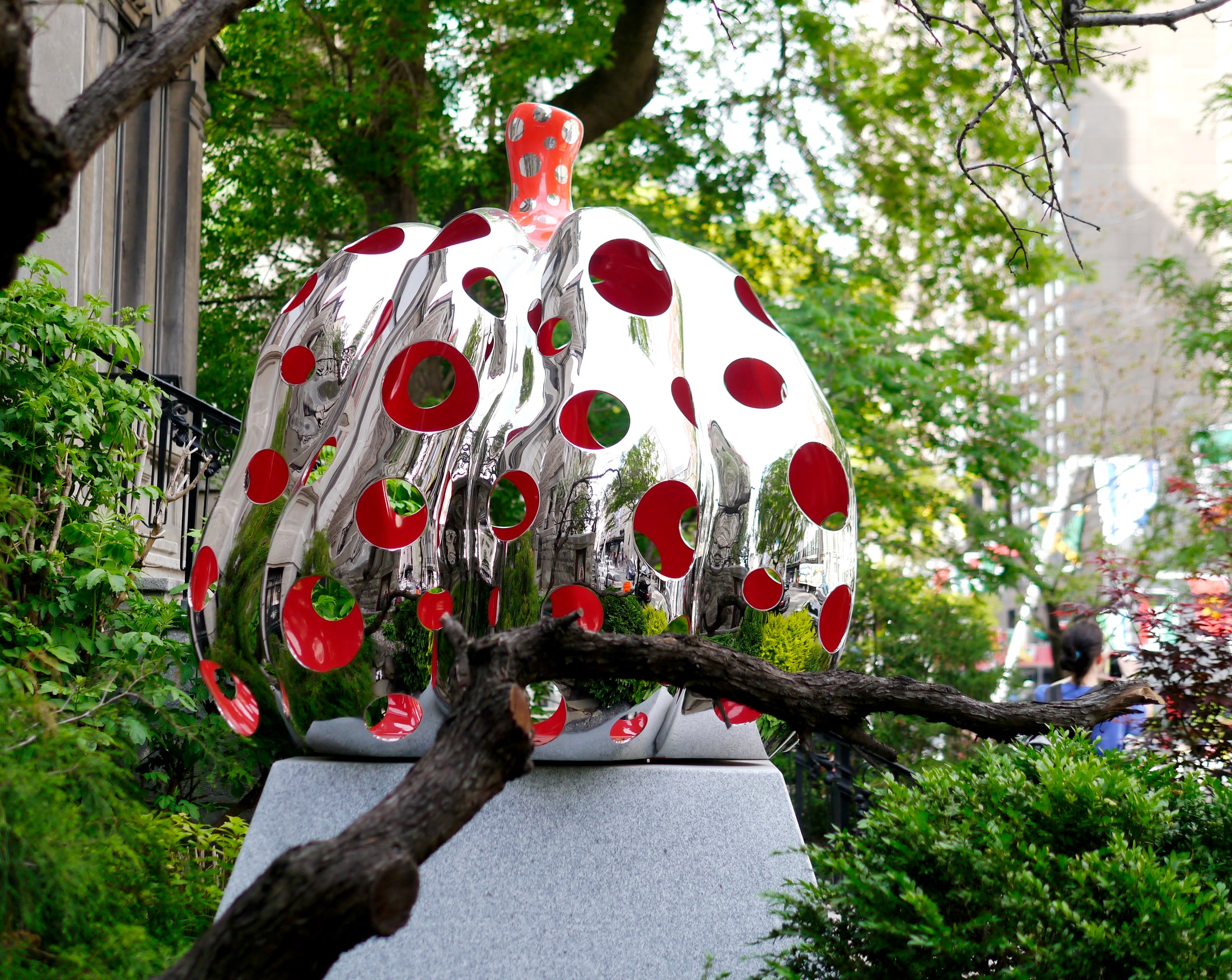
By then, the world had caught up with her. The public response to the mirror rooms, paintings, pumpkins and participatory installations became extraordinary. Near the end of her life, the National Gallery of Victoria mounted a vast retrospective spanning work made from childhood to 2024. It became the best attended ticketed exhibition in the gallery’s history.[7]
What Remains
Yayoi Kusama’s life should not be compressed into a story about a hospital, just as her art should not be compressed into a story about hallucinations. She was a painter of immense stamina, a sculptor, novelist, poet, performer, filmmaker and organiser of public actions. She was also a brilliant author of her own public image, long before the art world understood how much that could matter.
She kept painting until her final days. The dots remain, but so do the nets, rooms, books, performances, mirrored lights, flowers and pumpkins. Together they form the record of a singular imagination that never stopped expanding, and of one of the greatest artists of our lifetimes.
Sources
Numbered references connect factual claims in the article to museum, artist and exhibition records.
-
Announcement of the Passing of Yayoi Kusama
Yayoi Kusama Museum and Yayoi Kusama Foundation. Used for: the date and place of her death and the statement that she painted until her final days. ↩ -
Yayoi Kusama Timeline
Queensland Art Gallery and Gallery of Modern Art. Used for: her training, New York career, return to Japan, writing, exhibitions and Seiwa chronology. ↩ -
Love Forever: Yayoi Kusama, 1958–1968
The Museum of Modern Art. Used for: the Infinity Nets and the scale, labour and ambition of her New York work. ↩ -
Narcissus Garden by Yayoi Kusama
MoMA PS1. Used for: the 1966 Venice presentation and its critique of the commercial art world. ↩ -
Yayoi Kusama, The Clouds, 1984
Whitney Museum of American Art. Used for: her nearby studio, working routine and evening writing practice. ↩ -
Infinity Mirror Rooms
Hirshhorn Museum and Sculpture Garden, Smithsonian Institution. Used for: the first mirror room, audience participation and the themes of infinity, life, love and death. ↩ -
Yayoi Kusama Sets the Record for NGV’s Highest Attended Ticketed Exhibition
National Gallery of Victoria. Used for: the continuing public reach of her work late in her life. ↩
Sources checked 28 August 2026.


.jpg)