


Heracles captured Pylos after defeating Neleus, his sons, and the city’s defenders, while Hades aided the Pylians and was wounded in the fighting. Periclymenus changed shape during combat, yet Heracles killed him, leaving Nestor as the sole surviving son of Neleus.
Heracles Attacks Pylos
After taking Elis, Heracles marched against Pylos. Neleus and the Pylians resisted him, and a battle began for the city. Heracles overcame the defenders and captured Pylos. Periclymenus, the bravest of Neleus’ sons, fought against him. Periclymenus could change his shape during combat, but Heracles killed him despite this power.
Neleus also fell in the fighting. Heracles killed all of Neleus’ sons except Nestor, who was still a boy and was being raised among the Gerenians. Another account says that Neleus had twelve sons and that Heracles killed eleven of them. Nestor was therefore the sole survivor of the family. He remained the only son of Neleus to live beyond the destruction of Pylos.
Hades came to the aid of the Pylians during the battle. Heracles wounded him while fighting for the city. After Pylos had fallen and Neleus and his sons had been defeated, Heracles later marched against Lacedaimon. The sons of Hippocoon had supported Neleus, so Heracles attacked them in a separate campaign. That expedition followed the capture of Pylos and was not part of the fighting for the city itself.
The Belt of Hippolyta
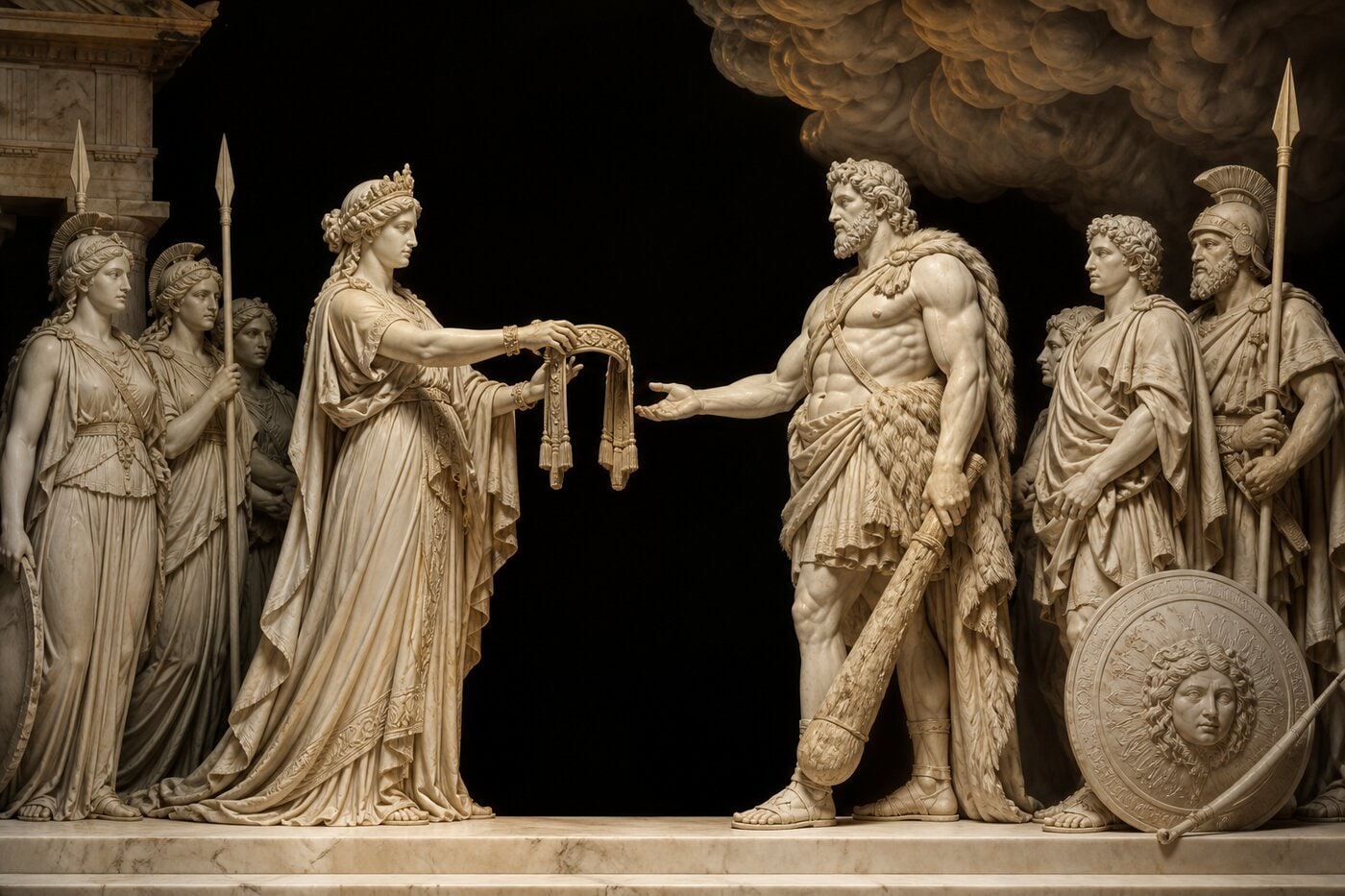
Heracles set sail in a single ship with a group of volunteers to obtain the belt of Hippolyta, queen of the Amazons. Eurystheus had ordered this as Heracles’ ninth labour because his daughter Admeta wanted the belt. The Amazons lived by the River Thermodon and were skilled in war. Hippolyta kept the belt as a sign of her supremacy among them. It had once belonged to Ares, the war god.
When Heracles and his companions reached the land of the Amazons, Hippolyta went to ask what they wanted. Heracles told her that he had come for the belt. She promised to give it to him. In some accounts, the two champions were attracted to each other, and Hippolyta offered the belt freely.
Hera then intervened. Disguised as an Amazon, she spread a rumour that the newcomers intended to seize their queen. The Amazons believed her and attacked Heracles and his men. The peaceful meeting became a battle. In the account where Hippolyta is killed, Heracles struck her down, took the belt from her body, and fled towards his ships. One version also says that he took her battle axe.
The belt was a prized war belt rather than an item of intimate clothing. It was heavy protective armour worn over clothing, with ornaments and fittings of gold and bronze. Euripides described it as embroidered with gold. Other accounts give a different course to the fighting. Orosius says that the Amazon queen Orithyia was away at war, leaving Hippolyta, Antiope, and Melanippe with a small force. Heracles then attacked by surprise while the Amazons were unprepared. In every version preserved here, he obtained the belt and returned with the object sought by Admeta.
Heracles on Mount Oeta
As the tunic grew warm during the sacrifice, the Hydra poison within it began to act. Heracles was seized by terrible pain, as if he were burning. He tore at the garment, but it clung to his body and brought away pieces of his flesh. The suffering did not kill him. He remained alive, though he was in torment. In his first agony, he seized Lichas, who had brought the tunic, and hurled him from Mount Oeta into the Euboic Sea.
The tunic had been sent by Deianeira. Heracles had captured Iole after sacking Oichalia and killing Eurytos and his sons. He then remained at Cenaion to sacrifice to Zeus, while Lichas went to Trachis for fine clothing. Deianeira feared that Heracles loved Iole more than her. She rubbed the tunic with what she believed was a love potion made from the blood of Nessos. In fact, the blood had been poisoned by the Hydra venom carried into Nessos by Heracles’ arrow. Deianeira learned what the garment had done and killed herself.
Heracles could still kill others, but he could not die from the poison. Since death would not come to him, he decided to go to death. He ordered those around him to build a great pyre on Mount Oeta and carry him to it. When he reached the pyre, he knew that he could now die and welcomed the end. He lay upon the pile with his head resting on his club and the lion’s skin spread over him. His face was calm, as if he were taking his place at a feast.
Heracles commanded that the torch be applied. The flames spread across the pyre and covered it. The gods were troubled as they watched him perish. The immortal part of Heracles was then taken to Olympus by Zeus, and Heracles ascended through the flames to the gods. The site on Mount Oeta later held a fire festival with ox sacrifices and contests.


