


Orestes sought Athena’s protection after killing Clytemnestra to avenge Agamemnon. Athena established a court on the Areopagus and appointed Athenian jurors. Their equal votes led her to acquit him, then she gave the Erinyes honours in Attica.
Athena Establishes the Areopagus
The Erinyes pursued Orestes from Delphi as he travelled to Athens. He sought Athena’s protection after killing his mother, Clytemnestra, to avenge the murder of his father, Agamemnon. Apollo had ordered the act. The Erinyes demanded punishment for matricide, while Orestes maintained that Apollo had commanded him and that he had been cleansed of his guilt.
Athena listened to Orestes’ plea. Apollo stood beside him and accepted responsibility for the killing, saying that Orestes had acted on his command. The Erinyes opposed him and called for vengeance. Athena decided that the case required a trial. She established the court on the Areopagus hill and selected jurors from the citizens of Athens to represent the city.
At the trial, the Erinyes questioned and accused Orestes. Apollo defended him. He argued that Orestes had acted in revenge for his father’s murder and spoke of the authority of Zeus. Orestes admitted that he had killed his mother, but repeated that Apollo had ordered the deed and that he had been cleansed. The jurors cast their votes. They were evenly divided, so Athena gave the deciding vote for acquittal.
Athena then persuaded the Erinyes to accept the verdict. Their anger had threatened Athens, but they agreed to receive honours and a home in Attica. They were changed from frightful Furies into the Eumenides, the Benignant Ones, who protected suppliants. Athena’s court settled Orestes’ case and established a lawful place where future blood feuds could be judged instead of answered by further revenge.
Athena and Arachne
Arachne spun and wove wool in Hypaepa, a village in Lydia. She was of common birth, the daughter of a humble wool dyer, and her mother was dead. Her skill made her famous throughout the towns of Lydia. Even the local nymphs came to see her work. Arachne refused to admit that the goddess of weaving had taught her. She declared that she would gladly compete with the goddess herself.
Athena heard this claim and went to Arachne disguised as an old woman. She advised the girl to challenge mortals, not a goddess, and urged her to ask forgiveness for her words. Arachne rejected the advice. She said that she was not afraid of the goddess and would stand by her challenge. Athena then cast off her disguise and appeared in her divine form. Arachne remained defiant, and the contest began.
The two women set up their looms and stretched the warp. They worked with fine coloured threads, including gold and silver. Athena wove into her design the contest in which she had prevailed over Neptune. Arachne completed her own cloth at the same time. It was every bit as beautiful as Athena’s and was not inferior in skill. Her work was an impious challenge to the gods, and Athena was overcome with anger.
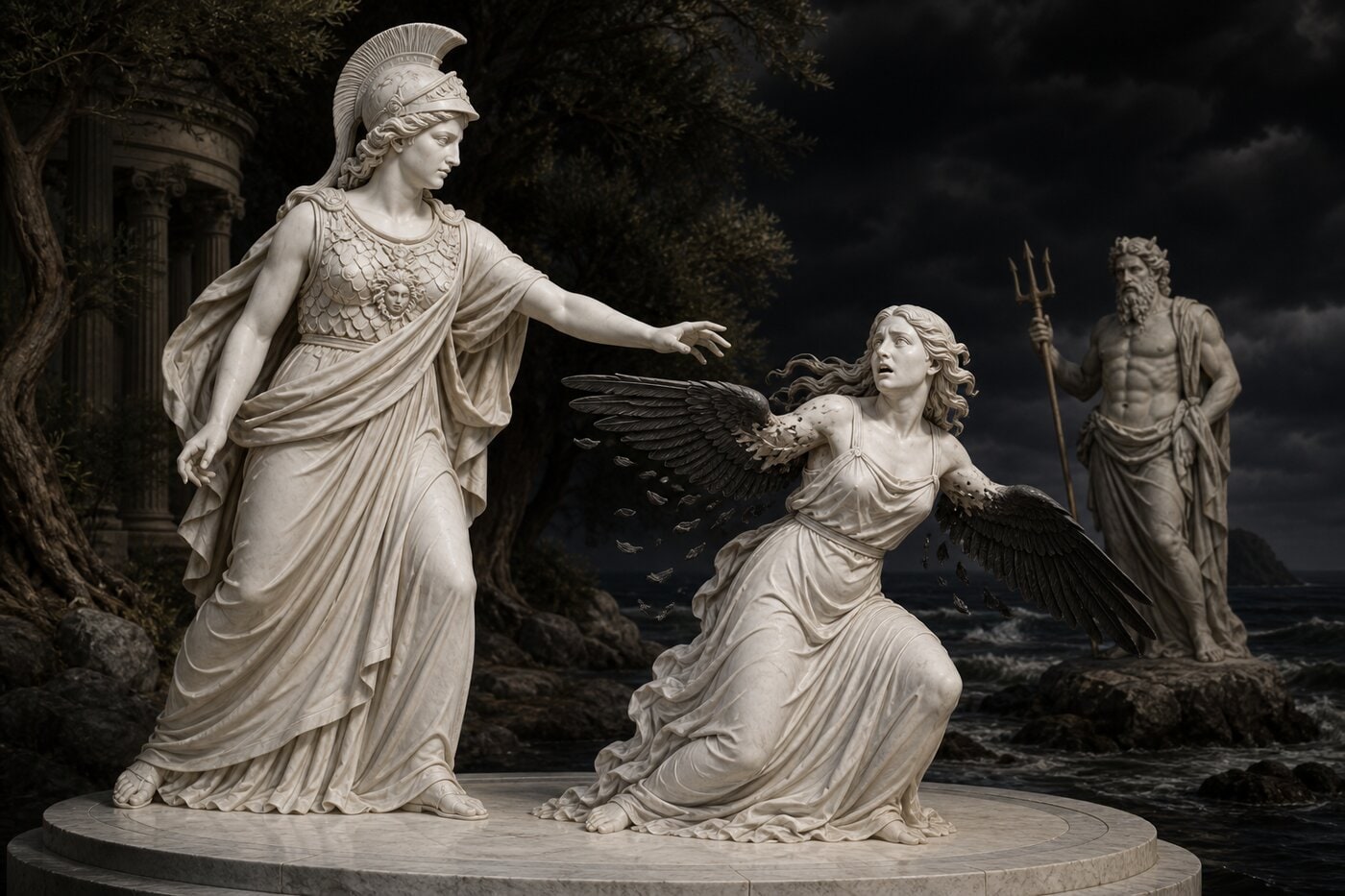
Athena destroyed Arachne’s cloth and broke her loom. She struck the mortal with part of it, then transformed her into a spider. Arachne’s skill in weaving remained, but she no longer worked as a human woman.
The Contest for Athens
Poseidon struck the Acropolis, the highest point in Athens, with his trident. A miraculous spring of salt water burst from the rock. The judges found this impressive. The spring represented the sea and naval power, and Poseidon sought patronage of the city and the surrounding land of Attica.
Athena then made an olive tree grow on the dry, rocky hill. The judges decided that her gift was better, so they declared her the winner. Athena became the patron deity of Athens. In one account, the contest took place during the reign of Cecrops. Athena planted the first olive tree beside Poseidon’s salt-water spring, taking possession of the land in a gentler manner.
Poseidon was angered by her claim and challenged Athena to single combat. Athena would have accepted, but Zeus intervened and ordered them to submit the dispute to arbitration. The two deities appeared before a divine court made up of their fellow gods and goddesses. The court called on Cecrops to give evidence. Zeus expressed no opinion. All the other gods supported Poseidon, while all the goddesses supported Athena. Athena therefore won by a majority of one, because the court judged that she had given the land the better gift.
Other accounts present the contest more briefly. Zeus and several divine judges decide which deity performs the most spectacular feat. Poseidon produces the salt-water spring by touching the Acropolis with his trident, then Athena causes the olive tree to grow. The judges declare Athena the victor. The accounts agree that her olive tree wins the contest and that she becomes Athens’ patron.


