


Seth attacked Osiris and his remains were recovered by Isis and Nephthys before Anubis prepared the body as the first mummy. He guarded the corpse against Seth’s assaults, while its restoration became a model for Egyptian embalming, burial, and protection of the dead.
Anubis Guards the Body of Osiris
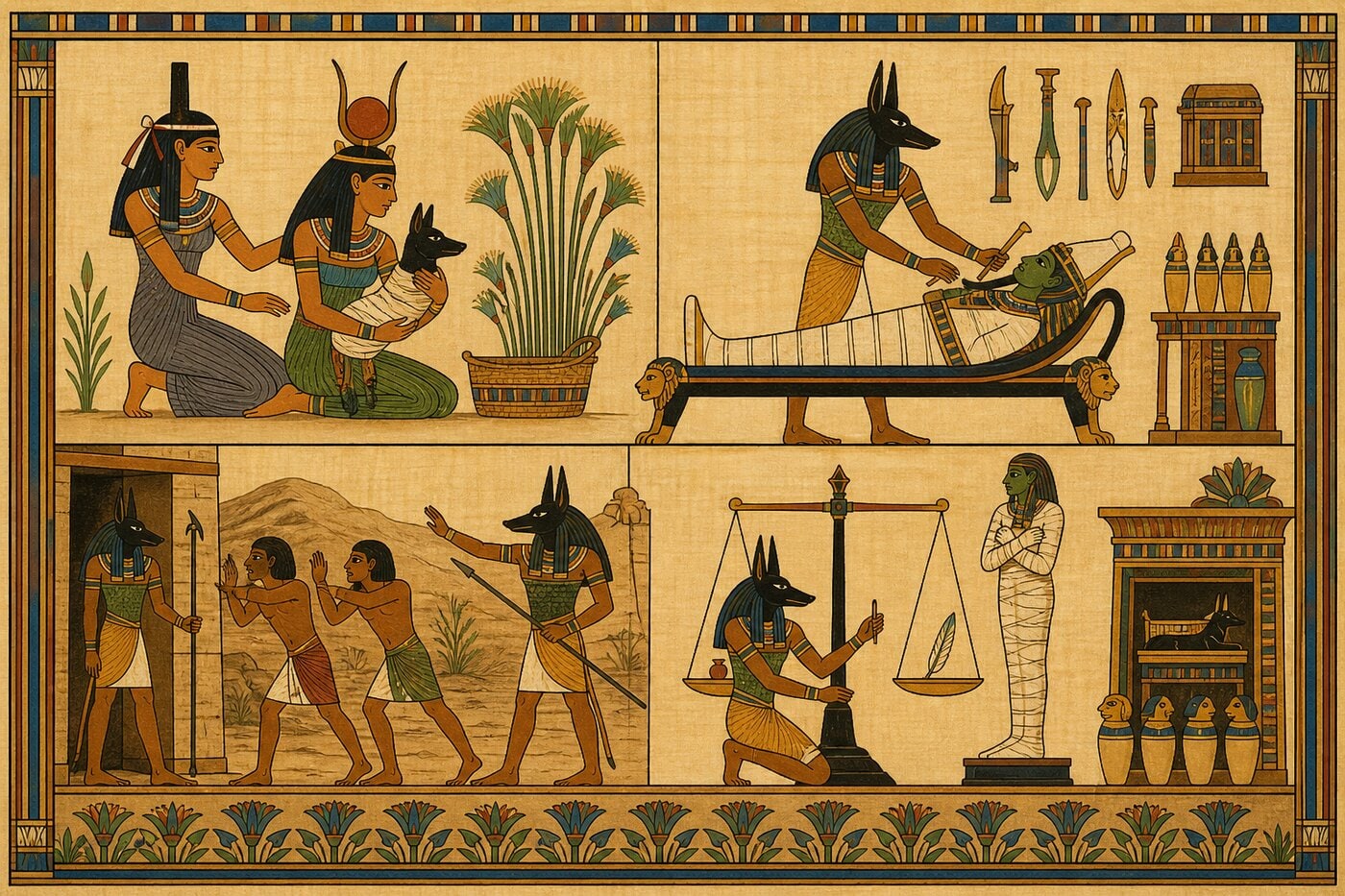
Seth attacked Osiris and cast him into the Nile. Some traditions say that Seth took the form of a bull, a hippopotamus, or a crocodile. Other accounts say that he struck Osiris down, trampled him, or tore his body apart. Isis and Nephthys searched for the remains and found them. Isis used magic to reverse the effects of decay.
Anubis prepared Osiris’s body. He supplied unguents and medicines and made Osiris into the first mummy. Isis and Horus preserved the remains, while Anubis guarded them. The burial and restoration of Osiris became a model for Egyptian funerary rites, including embalming, entombment, and the restoration of the dead body.
Seth and his followers repeatedly tried to destroy or despoil the corpse. Thoth’s magic and Anubis’s force protected it. Anubis guarded the tomb as Lord of the Sacred Land. His messengers punished those who violated burials or offended the gods. In a story recorded in the first millennium BCE, Seth disguised himself as a leopard and approached Osiris’s body. Anubis seized him and branded him with a hot iron. He flayed Seth and wore the bloody skin as a warning to evildoers. The branding marks were said to explain the leopard’s spots.
In Papyrus Jumilhac, Anubis, the Sons of Horus, and other gods defeat Seth and imprison him beneath Osiris’s throne. Isis, Horus, and Anubis continue to protect the restored body.
The Birth and Rescue of Anubis
After Osiris died, dogs led Isis to the infant Anubis. She found him and saved his life. Anubis was the son of Nephthys and Osiris. Nephthys had deceived Osiris into giving her this son. Isis adopted the child and raised him, while Nephthys remained beside her through the troubles surrounding Osiris and his family.
When Anubis grew up, he became Isis's guard. He also became associated with the dead and with the rites performed for them. He presided over the mummification of bodies and guarded burials. He watched over the body, the tomb, and the proper treatment of the deceased. He protected the dead from those who threatened them and punished those who violated tombs or offended the gods.
After Osiris's body was recovered, Anubis helped prepare it. He administered medicines as well as poison, and he provided unguents and rare medicaments. In the struggle over Osiris's remains, he guarded the corpse from Seth and Seth's followers. He prevented them from despoiling the body and watched over the tomb where the remains rested.
Anubis therefore remained beside the dead as their guardian. His care extended from the body and its preparation to the tomb and the defence of Osiris's remains.
Anubis and Bata
Anubis accepted his wife’s accusation against his brother Bata. She falsely claimed that Bata had tried to rape her. Deceived by the charge, Anubis turned against Bata, although Bata was innocent. The brothers share the names of the gods Anubis and Bata and possess some superhuman powers.
Bata fled from Anubis. Anubis pursued him. He later killed the wife whose false accusation had caused the conflict. The tale belongs to a setting where gods and monsters could be encountered beyond Egypt’s borders. It also contains the motif of the sea attempting to seize a beautiful woman. The supplied account does not explain how that event connects with the brothers’ pursuit.
Bata’s life was bound to his heart. After Bata’s death, Anubis found the heart that carried his brother’s life and restored it. Bata returned to life. The tale is identified with the story of the Two Brothers, but the supplied passages do not preserve the full sequence of Bata’s flight, the wife’s later betrayal, or the circumstances in which Anubis found the heart. They also do not identify a primary source for this version.


