


Johann Bayer published his celestial atlas, Uranometria, in Augsburg in 1603. The volume contained detailed maps of constellations alongside an engraved title page. This illustration combined classical myth, geometry, and municipal iconography into a non-controversial emblem of early seventeenth-century astronomical study.
The Publication of Bayer's Celestial Maps
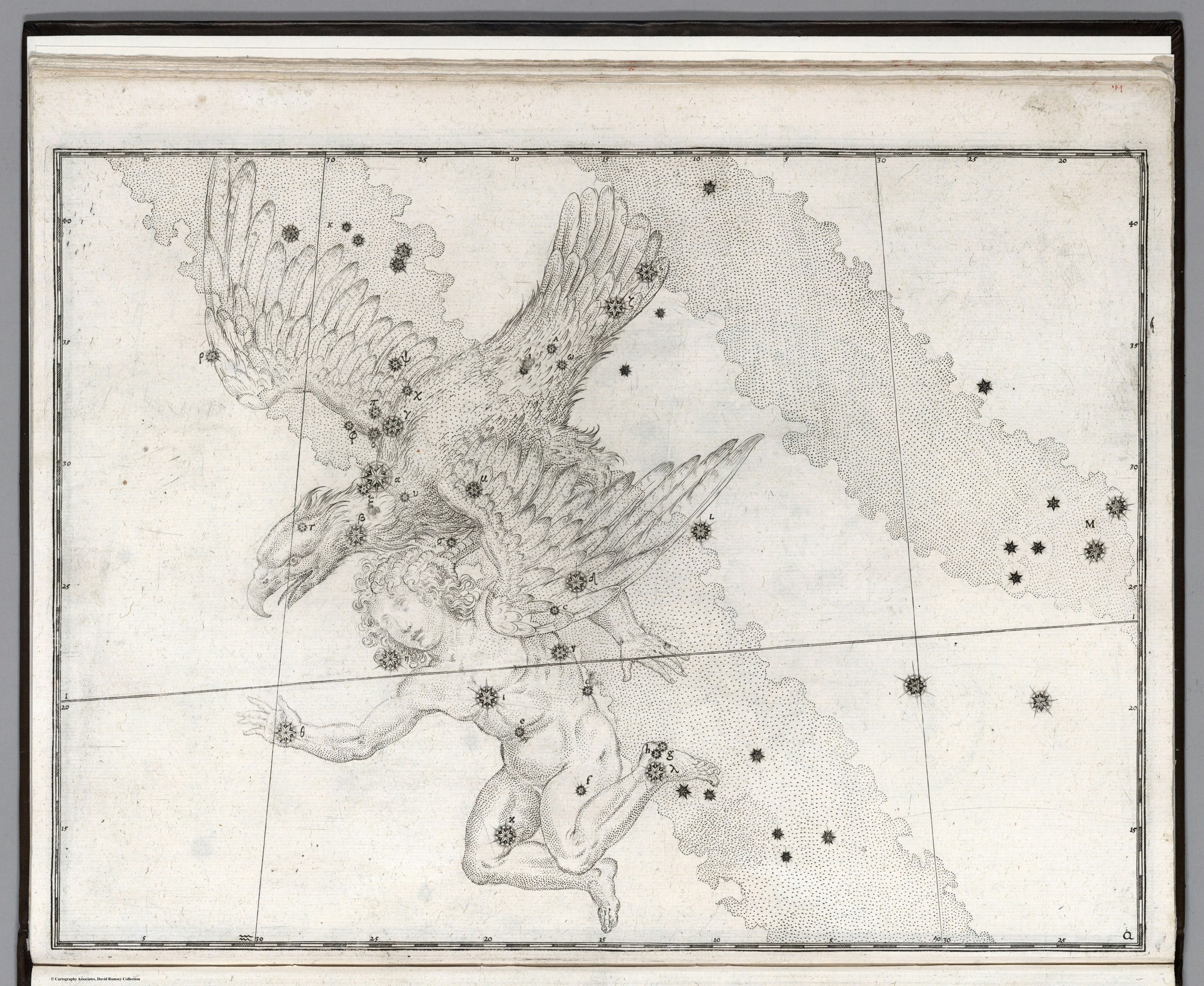
In 1603, Johann Bayer published Uranometria in the German city of Augsburg. Dedicated to Augsburg itself, the publication features a view of the city at the base of its engraved title page. Uranometria was created as a collection of celestial charts mapping the constellations. Positioned directly beneath the primary figures on the title page rests the figure of Capricorn. This image was taken directly from one of the internal constellation plates. Its presence on the architectural frame was a direct visual reminder that the volume was fundamentally a catalogue of star maps.
During the late Renaissance, engraved title pages became a standard method for introducing printed books. Authors and printers used these visual gateways to suggest the subject matter of a treatise through allegorical figures. Scientific publications adopted this convention across multiple disciplines. Astronomical and optical treatises conformed to an unwritten code of neutrality until approximately 1620. They avoided the fierce intellectual controversies of the era. Bayer’s Uranometria fits this peaceful tradition, presenting traditional mythological imagery without engaging in contemporary disputes regarding heliocentric or geocentric arrangements of the universe.
Mythological Personifications of the Sky
The upper portion of the title page presents three allegorical personifications representing astronomical subjects. On the left reclines Apollo, representing the sun, identified by his lyre and solar glory. On the right sits a composite female figure combining attributes of Artemis and Astraea. She carries the bow and quiver of Artemis, accompanied by a hound of Actaeon and a moon upon her forehead. She also wears a cloak covered in stars, a garment characteristic of Astraea, the goddess who departed the earth at the close of the Golden Age to become the constellation Virgo.
Between Apollo and the Artemis figure sits Cybele, the earth goddess. Cybele occupies the exact centre of the composition, drawn in a chariot pulled by two lions. Together, these mythological figures represent the sun, moon, earth, and stars. Because these emblems were firmly established in classical tradition, their symbolic meaning was easy for readers to interpret. The three figures recline above the text panel without dramatic tension. Their balanced arrangement reinforces the non-polemical tone of the atlas, providing a decorative tribute to astronomical science rather than a partisan statement.
Atlas, Hercules, and the Greek Inscription
Two large flanking figures frame the central text of the title page. On the left stands Atlas, set against a pillar transformed into a mountain cave. The legend carved onto the plinth beneath his feet identifies Atlas as the first teacher of astronomy. On the right stands Hercules in a contrapposto posture. The legend on his plinth labels him as the first pupil of astronomy. This pairing refers to the myth where Atlas persuaded Hercules to hold up the sky while Atlas retrieved the golden apples of the Hesperides. Hercules agreed, but later tricked Atlas into reassuming the load.
The frieze directly above these figures contains an inscription in Greek, translating as: "Let no one enter here who is ignorant of geometry." According to ancient tradition, this warning was inscribed above the door of Plato’s Academy in Athens. Its inclusion on Bayer’s title page declared that astronomy was fundamentally a branch of mathematics. In 1603, this statement was a universally accepted truism across European universities. While a similar declaration would arouse controversy twenty years later during debates involving Galileo, Bayer’s usage was uncontentious, reflecting established academic consensus at the time of publication.
Neutrality and Science in Early Print
Certain visual elements on the title page might tempt modern viewers to look for hidden cosmological arguments. For example, the stationary pose of Apollo and the active movement of Cybele could be misread as an argument for a stationary sun and a moving earth. However, such an interpretation is unwarranted. Bayer was not a Copernican and did not advocate for a heliocentric system. The visual rendering reflected standard artistic choices rather than a veiled defence of new astronomical theories. The title page was devoid of polemic, functioning as an emblem of academic harmony.
Scientific frontispieces altered significantly in tone between 1620 and 1650, becoming active instruments in scientific disputes. Before this shift, treatises on astronomy preserved a strictly neutral presentation. Bayer’s Uranometria reflects the earlier era of scientific printing, in which frontispieces summarized knowledge rather than challenging orthodoxy. Other contemporary works followed this pattern. For example, François Aguilon’s Opticorum, published in Antwerp in 1616 with plates engraved by T. Galle after drawings by Peter Paul Rubens, similarly relied on allegorical figures to outline optical principles without engaging in ideological battles.
Early Medieval Manuscript Traditions
Bayer’s seventeenth-century atlas rested upon a long tradition of star cataloguing originating in antiquity. The foundational literary text was the Phaenomena, written in the third century B.C. by Aratus at the Antigonid court in Athens. Aratus compiled descriptions of the fixed stars and constellations, which were translated into Latin by writers including Germanicus and Avienus. In the eighth century, a Latin translation was edited into the Revised Aratus Latinus. This revised text stripped away much of the original poetic phrasing, leaving a series of astronomical fables followed by star catalogues that circulated widely in medieval Europe.
Ninth-century manuscripts illustrate how scribes organized these star catalogues. A manuscript produced in Cologne around 805 under Archbishop Hildebald contains descriptions and drawings of forty-one constellations accompanying texts by Bede and Isidore. In its miniature for Hercules, the hero raises his club toward a serpent in a tree while wearing a lion skin across his arm. Bavarian manuscripts from the same period, linked to Arn of Salzburg and Hildebald of Mondsee, introduced technical advancements. These manuscripts arranged forty-two constellations into two-column layouts placed before the text and used distinct colours to mark individual stars, such as those forming the left hand of Perseus.


